Housing slump spreads as Brisbane and Adelaide join the slide

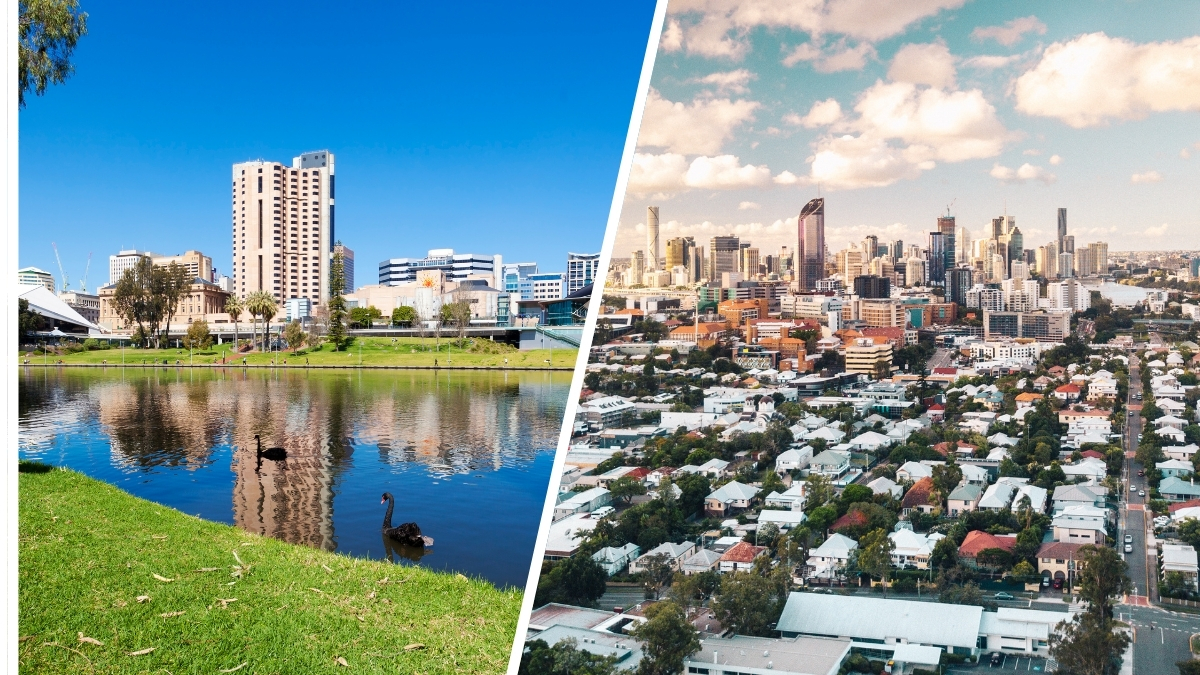
- Australia’s housing downturn is spreading, with Brisbane and Adelaide joining Sydney and Melbourne in recording price declines.
- National home values fell 0.7% in July, the sharpest monthly drop since December 2022.
- Most sellers are still making strong profits, but signs of strain are emerging in Melbourne’s unit market and regional areas.
What began as a pullback in Sydney and Melbourne is now taking hold across a broader set of markets, as weakening demand and rising supply push the housing cycle into a more entrenched phase.
Cotality’s Home Value Index fell 0.7% in July, the steepest monthly decline since December 2022, confirming the slump is no longer confined to the largest capitals.
Brisbane and Adelaide, two markets that had previously defied the slowdown, also slipped into decline, signalling a faster-than-expected loss of momentum across the cycle.
Sydney and Melbourne remain at the epicentre, with values dropping 1.4% and 1.2%, respectively, over the month, Cotality data shows.
Market | Monthly change | Quarterly change | Annual change | Median value |
Sydney | -1.4% | -4.0% | -2.0% | $1,244,617 |
Melbourne | -1.2% | -3.4% | -2.8% | $797,354 |
Brisbane | -0.6% | -0.6% | 14.8% | $1,104,094 |
Adelaide | -0.2% | 0.1% | 10.5% | $944,909 |
Perth | 0.1% | -0.3% | 20.5% | $1,029,797 |
Canberra | -1.0% | -2.1% | 1.0% | $883,138 |
Combined capitals | -0.9% | -2.5% | 3.9% | $1,010,814 |
Combined regional | -0.2% | -0.1% | 9.7% | $769,867 |
National | -0.7% | -1.9% | 5.3% | $928,421 |
Source: Cotality
But the more telling signal is the breadth of the pullback. Brisbane values fell 0.6% and Adelaide dipped 0.2%, both recording a second consecutive monthly decline. Even Perth, one of the strongest performers through late 2025, is showing signs of strain after revisions revealed a sharper-than-expected June contraction.
Separate data from PropTrack reinforces the shift, showing national home prices have now fallen for four consecutive months, down 0.3% in July and 1.8% from their peak.
Prices declined in every capital except Darwin, as higher interest rates and cost-of-living pressures weigh on borrowing capacity and buyer confidence.
Despite the downturn, annual growth remains positive at 3.9%, with stronger gains still evident in Perth, Darwin, Brisbane and Adelaide, highlighting the uneven nature of the correction.
The weakness is most pronounced at the top end. Nationally, upper-quartile home values plunged 3.2% over the three months to July, while lower-priced properties recorded a modest 0.3% gain, underscoring how affordability constraints are hitting higher-value segments hardest.
Sellers pull back as demand weakens
Affordability pressures, tighter borrowing capacity, and three cash rate hikes this year have eroded buyer demand, while higher fuel costs and weak consumer sentiment have added to the drag.
At the same time, sellers have been slower to adjust expectations, creating a widening gap between buyers and vendors.
According to Cotality Head of Research Gerard Burg, this shift is increasingly visible in listings data.
“We have observed a deterioration in the flow of new listings across the country in recent weeks, led by Sydney, as potential vendors assess a weak market and choose to wait until conditions improve,” Mr Burg said.
“However, this trend has lagged the decline in demand, as evidenced by total listings numbers that have continued to track higher.”
Auction clearance rates across capital cities have remained below 50% since late May, while total advertised supply sits 5.7% above the five-year average, pointing to a market where demand is failing to absorb available stock.
Profits hold, but cracks emerge
Even as prices fall, years of strong growth continue to underpin significant gains for sellers.
Data from Domain shows 97.4% of house resales still delivered a profit in the first half of 2026, only marginally lower than late 2025.
Median profits remain at record highs, reaching $458,000 for houses and $237,000 for units nationally.
Sydney recorded the largest gains, with a median house resale profit of $739,500, while Perth and Brisbane remain among the strongest markets, where almost every resale generates a profit.
However, signs of strain are emerging beneath the surface.
In Melbourne, more than one in four unit sellers are now selling at a loss, the highest rate among the capitals.
Domain Chief Residential Economist Nicola Powell said the data points to a market becoming increasingly fragmented.
“This is the first sign that Australia’s long run of property profits is starting to ease, but it’s far from a collapse in seller fortunes,” Dr Powell said.
“Most homeowners are still making substantial gains, even as softer market conditions begin to affect resale outcomes.”
Regional markets, which had outperformed through much of the past year, are also starting to weaken.
Cotality figures show regional values fell 0.2% in July, the first decline since January 2023, led by a 0.4% drop in regional New South Wales.
The broadening downturn, combined with still-elevated supply and softening demand, points to a market that is losing momentum across multiple fronts.