APRA, Treasurer to ease rules for smaller banks: The silver bullet to banking productivity?

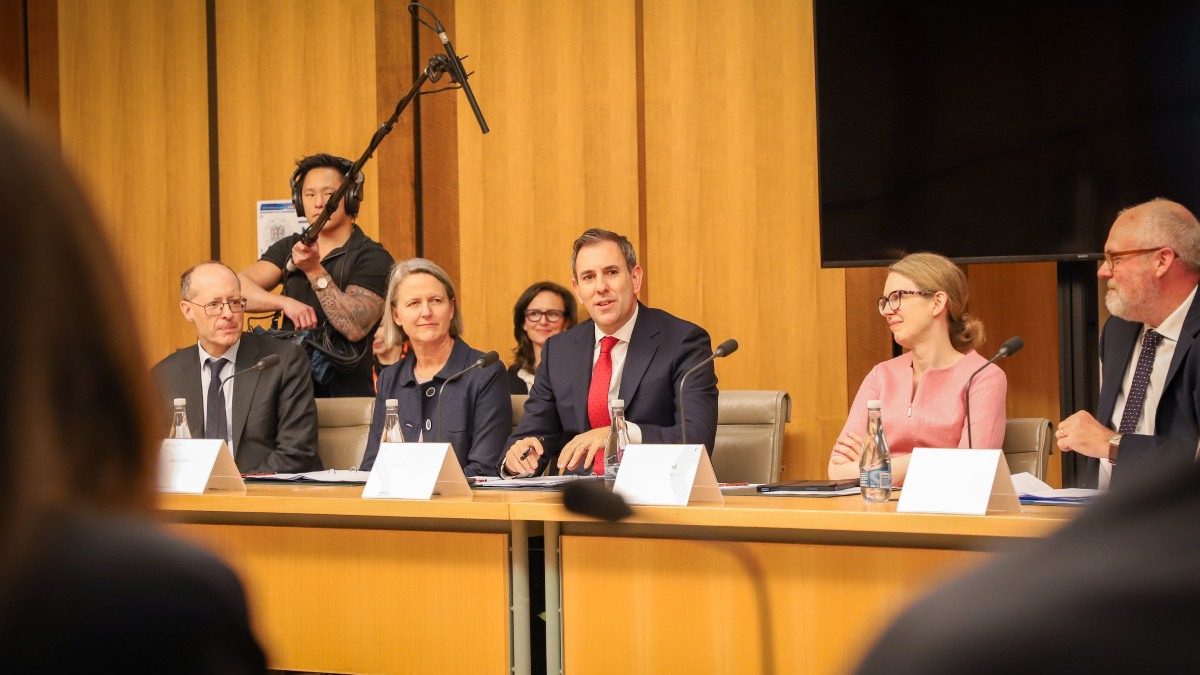
- APRA will ease reporting and capital requirements for smaller banks to allow them to scale and compete with larger banks as part of a tiered approach.
- The regulator will also seek to speed up the banking licence (ADI) approvals process.
- These are among the suggestions favoured by Treasurer Jim Chalmers at the productivity roundtable currently taking place.
APRA said Treasurer Jim Chalmers has given the green light for the regulator to adopt a "light touch" approach with small banks.
Among a raft of reforms, they all essentially boil down to opting for a tiered approach with regulations; major banks and bigger regionals will face tighter scrutiny while small and new players can operate more freely.
Smaller banks will also have different minimal capital requirements and upstarts will have a streamlined process to full banking accreditation.
They will also be able to use an internal-ratings-based approach to calculate risk-weighted assets.
Reporting will also be less onerous, removing the necessity of reporting breaches to ASIC unless deemed significant, and submitting a simplified compliance certificate.
This review forms part of the Treasurer's productivity roundtable (pictured above) currently taking place with businesses and industry leaders.
APRA found that challenger banks had increased their market share since the Global Financial Crisis of 2007-09 but still face significant barriers to entry and scaling up.
While the current suggested guidelines seem opaque, APRA chair John Lonsdale said more details will be announced later.
"We recognise the challenges many of these institutions face at a time when banking is becoming increasingly digitised, and community expectations around cyber security and operational risk management are rising," he said.
"At a time of heightened global geopolitical uncertainty, robust regulation is vital to ensuring all banks remain safe, stable and treat their customers fairly. APRA is committed to efficient, right-sized regulation that supports safety, stability and good community outcomes while also supporting competition and innovation in the sector."
The Australian Banking Association - the lobby for the banks - was supportive of the measures.
"Having a diverse range of banks ultimately means more competition in the market and that delivers more choice and better outcomes for customers," CEO Anna Bligh said.
"In particular, we welcome moves to formalise more proportionate regulation, support lower funding costs and reduce unnecessary regulatory reporting."
Quicker process for new entries
Towards the end of July APRA also said it would speed up the application process for businesses seeking a banking licence.
Among the changes include more explicit entry criteria, and new entrants will have 12 months' runway to prove their mettle as a bank. APRA will then review this within three months.
This is different from the current Restricted ADI (RADI) framework, developed in 2018, which allows new entrants some freedoms before becoming a fully-fledged ADI; the expectation is for institutions to become a full bank within two years.
APRA said although the RADI framework provided useful guiderails to becoming a bank, the RADI update has received limited uptake in recent years.
"It is important that the licensing process is not unnecessarily burdensome and supports timely entry into the banking sector. Our intention is for these changes to help aspiring banks navigate the licensing process more efficiently and reduce the time and cost associated with obtaining a banking licence," APRA member Therese McCarthy said.
The success of new entrants has been mixed since the 2018 reforms:
| Brand | Founded | Fate |
| 86 400 | 2017, granted ADI in 2019 | Acquired by NAB, merged with ubank May 2022 |
| Alex | 2018 | Offers personal loans, deposits |
| Judo | 2016, granted ADI in 2019 | Offers term deposits and business lending products |
| Up | 2018 | Offers transaction and savings accounts, shares ADI with Bendigo Bank |
| Volt | 2017, granted ADI in 2019 | Folded in mid-2022, no live product |
| Xinja | 2017, granted ADI in 2019 | Folded in early 2021, returning all customers deposits |