

- Rent increase laws vary across Australia, with rules on frequency and notice periods determined by each state and territory.
- Most jurisdictions limit rent increases to once every 12 months; NT generally allows increases every six months.
- Landlords can usually raise rent in line with market conditions.
- Tenants may challenge increases they believe are excessive through relevant tribunal or authority.
If you're a landlord, it is within your rights to raise your tenants' weekly rent, especially if you realise what you're charging is too low or not representative of your property's worth.
However, rent increases aren't entirely at your discretion. Each state and territory has rules governing how often rent can be increased, the notice landlords must provide and, in some cases, the circumstances in which increases can occur.
If you're a renter, understanding your rights can help you determine whether your landlord's proposed rent increase is reasonable and what options may be available if you believe it's excessive.
See also: What rights do tenants have?
How do rent increases work in Australia?
Rent increases are very common in Australia; landlords aren't expected to keep their rent stagnant for long periods. However, there is no single national tenancy law in the country. Each state and territory has its own legislation governing how much notice must be given and what rights tenants have to challenge an increase.
While rules vary between jurisdictions, rent increases generally follow the same process:
- Landlord determines a new rental amount
- Landlord provides the required written notice
- Tenant pays the new rent once the notice period expires
In most states and territories, tenants can challenge a rent increase if they believe it is excessive compared to comparable properties in the area.
See also: How to rent out your investment property
What are the common reasons for increasing rent?
There are different reasons why landlords might consider increasing the rent, including:
- Market rents have risen and other comparable properties have upped their rents
- Demand for rental properties in the area is strong
- The property has been renovated/upgraded
- Operating costs have increased
Real estate research from property analytics firms, such as Cotality, Domain, and PropTrack, can provide insights into rental market shifts and help landlords understand what comparable properties may be achieving.
Nat Gordon, founder of independent property advisory and advocacy firm PROPOHOLIC, told Savings.com.au that rent increases based on what comparable properties are commanding in the local area provide a "strong justification".

Rent increases based on comparable properties
Landlords should start by looking at comparable properties currently available for lease in their suburb, as well as very recent leasing evidence where available. Rental markets can move quite quickly, so the more current the evidence, the more useful it is.
The important part of conducting a comparative market analysis (CMA) is to compare like with like. I recommend ranking comparable properties as 'inferior', 'similar', 'superior' to the subject property, taking into account factors such as location, size, condition, parking, outdoor space and other features.
For Jordan Pritchard, founder of Hippo Floors, "the fairest rent rises" are those tied to genuine improvements made to the property.
Mr Pritchard's Brisbane-based flooring company works with landlords upgrading rentals.

Rent increases based on property improvements
Features add a decent amount, typically in the range of $10–$50 a week per feature, depending on the property and suburb.
Air conditioning in Queensland is close to non-negotiable now. Hard flooring earns its increase twice: once in presentation, once in the wider tenant pool it opens up. Kitchens and bathrooms matter, but tenants pay for them at a discount compared to owner occupiers.
I've had landlord customers replace tired carpet with hybrid flooring as part of a refresh and successfully achieve increases of up to $200 a week, because the property genuinely presents and functions like a better home.
A tenant will wear an increase they can see.
Note, however, that rent increases are ultimately subject to tenancy laws, not just market conditions.
How often can landlords increase rent?
Most jurisdictions currently limit rent increases to once every 12 months. The Northern Territory is the exception, allowing rent increases every six months in certain circumstances.
Notice requirements, fixed term lease rules and other conditions vary.
- NSW – Once every 12 months
- VIC – Once every 12 months
- QLD – Once every 12 months
- WA – Once every 12 months
- SA – Once every 12 months
- TAS – Once every 12 months
- ACT – Once every 12 months
- NT – Once every 6 months
Recent reforms have made it harder to bypass these limits. In some jurisdictions, renewing a lease or moving a tenant from a fixed term to a periodic one does not reset the 12-month clock for rent increases.
See also: Leasing vs Renting a Property: What's the real difference?
Should landlords increase rent every 12 months?
Just because a landlord can increase rent every 12 months (or six in NT) does not necessarily mean they should.
Ms Gordon recommends reviewing the rent annually and making smaller, incremental increases when justified, rather than delaying rent reviews and imposing a much larger increase later on.
"This can help avoid rental shock and can make increases easier for tenants to budget for," she said.
In some cases, maintaining a good tenant may be worth more than achieving the highest possible rent.
"A reliable tenant who looks after the property and pays consistently has real value, and that should form part of the landlord's decision," Ms Gordon added.
How much notice does a landlord need to give?
A landlord cannot simply tell a tenant verbally that rent is increasing. Rent increases generally need to be officially documented and communicated in writing, with notice periods varying across states and territories.
The written notice typically includes:
- The new rent amount
- The date the increase will take effect
- Information required under the relevant state or territory jurisdiction
Rent increase notice periods by state and territory
- NSW – 60 days
- VIC – 90 days
- QLD – 2 months
- WA – 60 days
- SA – 60 days
- TAS – 60 days
- ACT – 8 weeks
- NT – 30 days
How much can a landlord increase rent by?
Most Australian states and territories do not impose a fixed dollar cap or percentage limit on how much a landlord can increase rent by (the ACT is the main exception). Landlords could increase it by, say, $100 a week if they wanted to, but that doesn't mean the tenants won't deem it excessive.
Generally, landlords are expected to set rents in line with market conditions and comply with their state's tenancy laws. This means a landlord may be able to increase by any amount, provided the increase is lawful and supported by market evidence.
A large increase may be challenged if a tenant believes it is excessive. This is where tribunals and tenancy authorities come in. They can review disputed rent increases and consider whether the new amount is reasonable or not.
Rent increase cap in the ACT
As of this writing, the ACT remains the only jurisdiction in Australia where rent increase amount is linked to a prescribed formula based on changes in the Consumer Price Index. Generally, landlords can increase rent by no more than 10% above the growth in the rents component of the CPI for Canberra.
Example:
If your current rent is $700 and Canberra's rents CPI increased by 3% since your latest rent increase (or the start of the tenancy agreement if the rent has not been increased), the rent can only be increased by 3.3% (or $23.1) from $700 to $723.10.
Landlords shouldn’t simply pick a number.
A reasonable increase should be supported by evidence and comply with the legislation applying in that state or territory.
Can tenants challenge a rent increase?
Yes. In every Australian state and territory, tenants generally have the right to challenge a rent increase if they believe it is excessive, unreasonable, or has not been implemented in accordance with tenancy laws in the respective jurisdiction.
The process varies by jurisdiction, but disputes are typically handled by the relevant tenancy tribunal or authority.
- NSW – NSW Civil and Administrative Tribunal (NCAT)
- VIC – Victorian Civil and Administrative Tribunal (VCAT)
- QLD – Queensland Civil and Administrative Tribunal (QCAT)
- WA – Magistrates Court of Western Australia
- SA – South Australian Civil and Administrative Tribunal (SACAT)
- TAS – Residential Tenancy Commissioner
- ACT – ACT Civil and Administrative Tribunal (ACAT)
- NT – Northern Territory Civil and Administrative Tribunal (NTCAT)
What happens when a tenant challenges a rent increase?
When a tenant challenges a rent increase, a tribunal or tenancy authority will typically assess whether the proposed rent is reasonable compared to the local market.
Tribunals commonly consider market evidence such as comparable rental listings, recent leasing activity and property improvements when assessing whether a rent increase is justified.
Depending on the outcome, the tribunal may allow the increase, reduce it, or disallow it altogether.
For rent increases based on comparative market analysis: Ms Gordon recommends keeping copies or screenshots of listings used in the assessment, including the date "as online listings can disappear once a property is leased".
She also suggests preparing a simple table ranking each comparable property as 'inferior', 'similar', or 'superior' to the subject property.
"This helps demonstrate that the proposed increase was justifiable and that the landlord or property manager genuinely considered how the property compares with others in the current market."
For rent increases based on property improvements: Mr Pritchard strongly advises keeping receipts and photos of improvements made to the property.
See also: How to find the right tenants for your investment property
What is considered an excessive rent increase?
There is no set amount or percentage that defines a rent increase 'excessive'. But the relevant tribunal will typically consider factors such as:
- The rent charged for comparable properties in the area
- The difference between the proposed and current rent
- The condition and location of the property
- Any improvements or renovations completed by the landlord
- The time since the last increase
For example, if similar properties in the neighbourhood are renting for around $650 per week, lifting rent from $600 to $630 may be easier to justify than increasing it to $750 without evidence that the property commands a higher market rent.
That said, a couple hundred dollars rent increase is possible as long as it's well supported and complies with tenancy laws.
Which property upgrades deliver the strongest rental returns?
Floors and paint are the easy wins. They're the two of the cheapest whole-property transformations and what sets a tenant's 'what would I pay for this?' number in the first 30 seconds of an inspection.
A hard-floored property suits more of the market (families, kids, pet owners) so more people apply, it lets faster, and that competition is what actually pushes the weekly rent up. Carpet quietly filters out a slice of good tenants who are worried about bonds and spills.
Mr Pritchard shared an example from a project his company completed in South Bank, Brisbane, where a landlord increased the rent after replacing carpet with a premium hybrid floor – roughly an $8,000 upgrade.
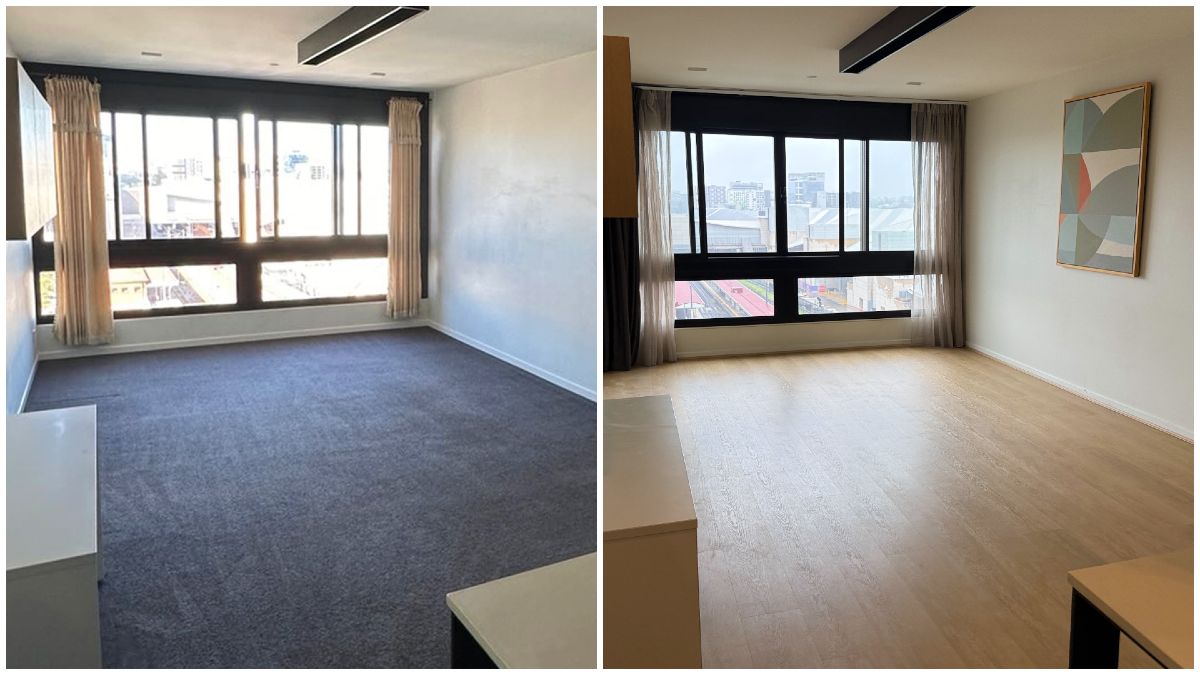
A rental property in Brisbane before (left) and after (right) replacing the carpet with a premium hybrid floor. (Image supplied)
"The rent went up from $900 to $1,150 a week, with a tenant secured at a new rate within about a month," he shared.
Compare rent increase laws across Australia
Here's a quick summary of rent increase laws in each Australian state and territory.
State/Territory | Maximum frequency of rent increase | Minimum notice period required | Rent increase limit | Dispute body |
NSW | Once every 12 months | 60 days | None | NCAT |
VIC | Once every 12 months | 90 days | None | VCAT |
QLD | Once every 12 months | 2 months | None | QCAT |
WA | Once every 12 months | 60 days | None | Magistrates Court |
SA | Once every 12 months | 60 days | None | SACAT |
TAS | Once every 12 months | 60 days | None | Residential Tenancy Commissioner |
ACT | Once every 12 months | 8 weeks | Capped at 110% of growth in Canberra rents CPI | ACAT |
NT | Once every 6 months | 30 days | None | NTCAT |
Correct at the time of writing and may be subject to change.
Fixed term lease rules by state and territory (2026)
- NSW – Rent increases are generally limited to once every 12 months regardless of lease type.
- VIC – Rent can only be increased if the agreement specifically allows for it and clearly sets out how the increase will be calculated.
- QLD – Rent can only be increased if the tenancy agreement includes a rent increase provision.
- WA – Rent can only be increased if the agreement states that rent may be increased and explains how it will be calculated.
- SA – Rent can only be increased if the tenancy agreement includes a clause allowing for rent increases.
- TAS – Rent can generally be increased if the agreement allows for it.
- ACT – Fixed term leases must comply with ACT rent increase rules, including the prescribed CPI-based cap where applicable.
- NT – Any rent increase must be permitted and outlined in the tenancy agreement.
Tenancy laws across Australian states and territories
Check out your state's specific rules in detail in the residential tenancies acts linked below.
Savings.com.au's two cents
Increasing rent is a normal part of managing an investment property. However, landlords should be careful not to treat it as an automatic annual exercise.
A rent increase should be based on market conditions, the property's features and condition, and the rules that apply in your state or territory.
For landlords, striking the right balance is important. Setting rent too low could affect your investment returns, while setting it too high may make it harder to attract or retain quality tenants and could even increase the risk of disputes.
Take the time to research comparable properties, review local market conditions and understand your legal obligations. If you're unsure what rent is appropriate, a property manager or experienced real estate professional may be able to help assess your property's market value and guide you through the process.
For tenants, knowing your rights can help you determine whether a proposed rent increase is reasonable and what options may be available if you believe it is excessive.