'Deeply concerning': Aussies increasingly exposed to property settlement scams


- PEXA research suggests Australians may not be adept at spotting property settlement scams.
- Buyers, sellers and real estate professionals are urged to be vigilant.
- PEXA is partnering with ex-Grand Designs Australia host to raise awareness of the issue.
According to Scamwatch, Australians lost $43.2 million to "buying and selling" scams in 2024.
Property transactions are frequent targets, and new research commissioned by PEXA suggests this might be a particularly vulnerable area.
Nearly all (97%) of those surveyed - people who either bought in the previous year or intend to in the next - failed to spot "dangerous scam indicators" in property transaction emails.
More alarmingly, 40% of the more than 1,000 respondents said they would have transferred money to the fraudulent account.
This might be for conveyancing, stamp duty or even the deposit - in one real example last year a Sydney couple transferred $970,000 to scammers, believing they were paying the seller.
PEXA is partnering with Peter Maddison, original Grand Designs Australia host and new PEXA Scam Awareness Ambassador, to help raise awareness.
"As someone who's spent decades in property and architecture, I find these results deeply concerning," Mr Maddison said.
"Property transactions are often the biggest financial decisions in people's lives.
"When scammers strike during these critical moments, the consequences can be devastating."
How do I spot a settlement scam?
Settlement scams will most commonly come as an email purportedly from the account of a real party involved in the settlement.
This might be a conveyancer, solicitor, or estate agent and often will be from either a lookalike email or even the real account, hacked by the scammers.
The timing is often right when you would expect the legitimate payment to be due - one tactic is to send "revised" bank account details different to where you thought you were sending the money.
Sophisticated scammers use legitimate-looking letterheads, signatures and attachments to make the email plausible.
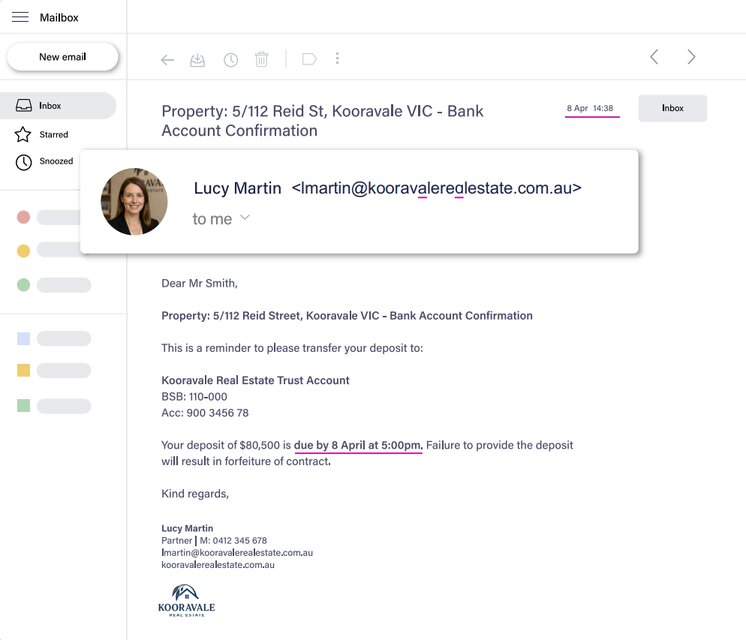
In the below example provided by PEXA, the only thing giving away the fraud is the different style a in the email address.
The urgent tone could make the victim panic, and transfer the money before double checking whether the amendment is correct.
More confidence = more vulnerability?
What makes PEXA's findings more alarming is that the majority of those surveyed believed they could identify scam attempts.
In fact, those with the highest confidence in their ability to spot fraud were more likely to transfer to the scam email (41%) compared to those with 'low or no confidence' (33%).
PEXA is urging all home buyers and sellers, no matter how impervious to scams they may feel, to be vigilant to the possibility of falling victim.
PEXA security experts and the Australian Cyber Security Centre (ACSC) have the following tips to buyers, sellers and professionals to avoid being caught out:
- Use secure communication platforms: Many property transactions now take place using secure messaging services to exchange bank details. Examples include PEXA Key and Secureexchange.
- Never trust unsolicited email instructions for payments: Buyers and sellers are urged to always verify any change in payment details through independent channels - calling the solicitor on a known number for example.
- Pay attention to Confirmation of Payee (CoP) warnings: Banks often display a warning if you're transferring to an account where the name doesn't match the number. If this warning pops up, it could be a sign to double check.
- Be alert to red flags: Signs of a scam include subtle misspellings in email addresses, or an urgent tone putting pressure on you to send money immediately.
- Protect your personal data: General cyber security is one of the best ways to avoid falling onto scammers' radar. Clicking suspicious links and attachments or providing personal information to unverified email requests is generally not advised.
- Act quickly if you suspect a mistake: One of the issues with property settlement fraud is the scam often isn't discovered until the legitimate payment is due. If you think you might have sent money to a criminal, you should contact your bank immediately.