Should you ever take out a payday loan?
Payday loans are short-term, high-cost loans that are often set up to be repaid over a short period, sometimes aligned with pay cycles – hence the name.


Dominic Beattie
- Group Editor
- Experienced finance editor
- Writer
- Commentator and researcher
Do you like & trust our expert, human-written content?
Simply click this button to tell Google you want to see more of us in your Google Search Results, AI Overviews and AI Mode answers.

- Payday loans are high-cost loans that are often set up to be repaid within 16 days to 12 months, sometimes aligned with pay cycles.
- Payday loan lenders are not allowed to charge interest, so they make up for it by charging fees.
- Payday loans typically appeal to people with bad credit and are already in financial distress, making them more at risk of falling into a debt spiral.
- Personal loans can be a viable alternative to payday loans, provided that you understand the difference between the two.
Payday loans allow you to borrow small amounts of money (generally up to $2,000, but some payday lenders may allow up to $5,000) that must be repaid within a period of 16 days to 12 months.
These loans are typically easy to get, and the money can be in your account in under an hour when approved. As such, payday loans are also called ‘fast loans’.
While you can technically borrow a cool 2k without even getting out of bed, that money is likely to come with a ton of strings attached to it – namely, the exorbitant fees that many people who take out these loans aren’t aware of.
How do payday loans work?
Many payday lenders will allow customers to select their own loan term, but the repayments are often made in line with your pay (such as fortnightly), typically as a direct debit from your bank account.
If there aren’t enough funds in the bank account to cover repayments, a failed direct debit will result in a charge by the lender and the bank. Which brings us to…
Payday loans rates and fees
Payday lenders aren’t allowed to charge interest, so they make up for it by charging fees instead.
According to the Australian Securities and Investment Commission (ASIC), payday lenders are only allowed to charge the following for loans under $2,000 with terms of between 16 days and one year:
- Establishment fee - the maximum fee is 20% of the borrowed amount
- Monthly service fee - the maximum fee is 4% of the borrowed amount
- Default fees - the maximum fee is 200% of the loan amount
- Missed payment fees
- Enforcement expenses - if the lender has to take you to court for failing to repay the loan
If this sounds expensive, it’s because it is.
- Take note: It’s these fees that cause many people to fall into a debt trap. For example, if you took out a payday loan for $1,000, you would have to pay a $200 establishment fee and a $40 monthly service fee, so you’ve technically taken out a $1,240 loan.
Payday loans typically appeal to people with bad credit ratings, who are already in financial distress, and can’t get a credit card or loan from anywhere else. In short, applicants most lenders would usually reject.
Payday loans eligibility requirements
Applying for a payday loan is often a fairly quick process that can be done online. Eligibility requirements vary by lenders, but applicants generally have to meet the following criteria:
- Be over the age of 18
- Be an Australian citizen or permanent resident
- Receive a regular income (even if that income is Centrelink benefits)
Applicants will often need to supply the lender with 90 days' worth of bank statements, identification, employment details, copies of bills or Centrelink receipts, and details about income, such as how much they earn each week.
What are the dangers of payday loans?
Payday loans are considered so dangerous that all payday lenders are actually forced under Australian consumer law to display this warning message to potential applicants:
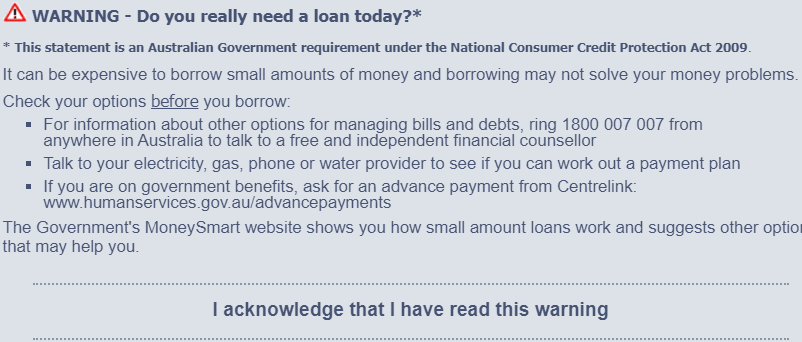
Despite this, many people still resort to taking out payday loans. That’s usually because the people who use these loans are often in a tough financial situation to begin with. They may be using payday loans to fund emergencies, bridge a gap in their budgets, or perhaps most worryingly, cover other debt repayments.
What’s the difference between payday loans and personal loans?
Personal loans allow you to borrow money from a lender and pay it back over time with interest. Unlike payday loans, you can generally borrow a larger amount with personal loans, typically up to $100,000, payable over up to seven years (generally, though some lenders may offer up to a 10-year term).
Personal loans can either be secured or unsecured.
- A secured personal loan means the loan amount is secured against an asset, typically the one the loan is financing (e.g. vehicle).
- An unsecured personal loan has no security, which makes them easier to get but will typically see you pay a higher interest rate.
Here are some of the main differences between payday loans and personal loans:
Loan length
- Personal loans typically range from five to seven years, but you may be able to pay them off sooner if your lender allows for additional repayments.
- Payday loans are legislated to run for no longer than one year and have a minimum length of 16 days.
Loan amount
- Personal loan borrowers can access up to $50,000-100,000.
- Payday loans are often small amount credit contracts, no more than $2,000, though some lenders may offer as high as $5,000.
Interest rates and fees
- Personal loans charge a fixed or variable interest rate for the period of the loan, and may also have other fees like application fees and monthly fees.
- Payday loans don’t charge interest, but typically come with multiple fees such as establishment fees, ongoing fees, and missed repayment fees.
Borrowers eligibility
- Personal loan lenders generally put potential borrowers through stringent criteria to ensure they can handle the repayments, often requiring proof of employment, recent paychecks, and a list of assets and liabilities.
- Payday loans generally have very few eligibility requirements; typically, only requiring borrowers to be an Australian citizen or permanent resident, over 18 years old, and have an income stream
Personal loans or payday loans? Questions to ask yourself before borrowing
If you’re tossing up between a personal loan and a payday loan, ask yourself the following questions:
How’s your credit score?
If you have a good credit score, you may be able to access more competitive rates from personal loans. When choosing between secured and unsecured, note that having collateral backing up the loan (as is the case with secured personal loans) typically means lower interest rates compared to the unsecured option.
If you have a bad credit score, personal loan lenders may see you as high risk and therefore be declined or be subjected to higher rates and/or stricter terms. In such cases, a payday loan may be more suitable, given their simplicity to obtain (therein lies their danger).
How much do you want to borrow?
If you want to make a purchase for anything over $5,000, then a personal loan is more suitable, as payday loans typically only let you borrow up to $2,000 or, in some cases, $5,000 max.
Conversely, for smaller amounts, payday loans may be more suitable, provided that you understand the additional fees that come with them.
How soon do you need the funds?
The marketing of payday lenders often centres on how quickly they can get the money to you, with some offering to do so in an hour.
Personal loans take longer (at least 1-2 days), with the timing dependent on the lender, what you’re purchasing, and whether the loan is secured or unsecured.
What can you afford?
Use calculators available online to see what your monthly repayments would be for a personal loan, such as this one if you’re looking at buying a car.
If you’re looking at a payday loan, find out all the information you can about fees and do your own budgeting to ensure you can afford it.
What do you need the funds for?
A personal loan may typically be more suitable for large purchases like a car or a holiday, while payday loans are often marketed towards people who need money for unforeseen expenses.
You think a personal loan is the right choice for you? The table below features personal loans with some of the lowest interest rates on the market.
| Lender | Car Loan | Interest Rate | Comparison Rate* | Monthly Repayment | Interest Type | Secured Type | Early Exit Fee | Ongoing Fee | Upfront Fee | Total Repayment | Early Repayment | Instant Approval | Online Application | Tags | Features | Link | Compare | Promoted Product | Disclosure |
|---|---|---|---|---|---|---|---|---|---|---|---|---|---|---|---|---|---|---|---|
6.24% p.a. | 6.95% p.a. | $389 | Variable | Unsecured | $0 | $10 | $495 | $23,334 | |||||||||||
5.95% p.a. | 5.95% p.a. | $386 | Fixed | Unsecured | $0 | $0 | $0 | $23,171 | |||||||||||
5.76% p.a. | 5.76% p.a. | $384 | Fixed | Unsecured | $0 | $0 | $275 | $23,066 |
|


Other alternatives to taking out a payday loan
Payday loans can present themselves as a ‘stop-gap’ solution, but it’s best to avoid using one at all if you can. If you’re strapped for cash, there are alternatives.
- Negotiate with your utility provider – If you’re having trouble paying your bills, most providers have hardship staff who can help you work out an alternative payment plan, such as paying off your bill in smaller instalments.
- Centrelink – If you’re eligible for Centrelink benefits, you may be able to get an advance payment on your benefits without interest charges.
Quick tip: What if you can’t afford to repay a payday loan?
If you think you won’t be able to make your next repayment, the first thing you should do is contact your lender and let them know. Some lenders have financial hardship departments that can help you out in moments like these and delay the next direct debit repayment.
Then, take a look at your budget and set enough money aside to make sure you will have enough in your account to make the next repayment. If you still don’t think you’ll be able to cover your repayments, get in touch with your lender again to discuss your options.
Savings.com.au’s two cents
Before taking out any loan or financial product, it’s important to understand how it works. The same is true for payday loans.
Payday loans could be helpful in those last-resort situations, but only when they’re used responsibly and paid back on time. That’s why borrowers should sit down and work out the true cost of the loan, and whether it will ultimately help or simply delay existing problems.