Why do house prices seem to appreciate faster than units?


Dominic Beattie
- Group Editor
- Experienced finance editor
- Writer
- Commentator and researcher
Do you like & trust our expert, human-written content?
Simply click this button to tell Google you want to see more of us in your Google Search Results, AI Overviews and AI Mode answers.

- Detached houses have historically seen higher appreciation in value than units in Australia
- House price growth gained momentum over unit price growth during the pandemic
- But there are more factors to consider in property investment than just 'buying a house'
Traditionally, the 'Australian Dream' has been a detached house with backyard. Many Aussies are still attached to the idea, as our sprawling cities attest compared to more dense capitals in Europe and Asia.
Indeed, house prices tend to be higher than unit prices in almost all Australian markets as well as appreciate at a greater rate, as the chart below illustrates:
National house-vs-unit value (from 2001)
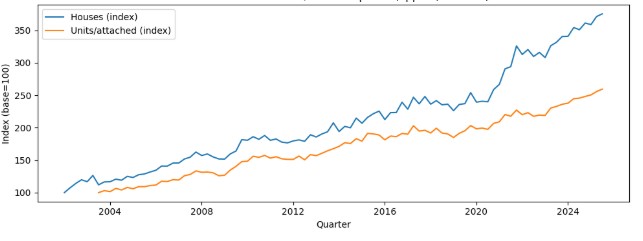
Source: House-vs-unit values based on ABS 'Total Value of Dwellings' median transfer prices data
House vs unit values: what does the data show?
It's notable that house and unit price growth was tracking relatively parallel until the COVID-19 pandemic when the two diverged considerably.
At the time, property analysts believed it to be a reaction to pandemic conditions where many people sought their own space during lockdowns and work-from-home arrangements that didn't require workers to live close to city offices.
Units, particularly inner-city apartments, became less desirable while larger suburban and regional blocks were seen to offer sanctuary and people were willing to pay more for them.
This divergence has continued on much the same trajectory in the years since although narrowed somewhat during 2022-23, marking the end of the pandemic era.
At the end of 2025, the price gap between the median detached house value ($1,091,000) and the median unit value ($728,000) was 49.9% - a record high.
Cotality data, November 2025
Why is there divergence between unit and house prices?
Long story short - it’s land. Land is a fixed resource, meaning we can't create more it.
Property price growth is largely driven by appreciation in land value. If you own all of the land your property is on, you're likely to reap the benefits of its appreciation over time.
If you own a unit, you'll own a proportional slice of the land it's on depending on how many units share it. This will generally see you reap less of a return on land value.
Should I invest in a house or a unit?
As we've established, detached houses historically appreciate more in value than units but there are also nuances for investors to consider.
Let's consider a few pros and cons of each option:
Investing in a house: pros & cons
Pros
- Higher appreciation: Historically, can lead to higher capital gains and return on investment
- Flexibility: Not bound by body corporate or strata management committees so you can make your own property decisions
- Good rental demand/higher rents: Houses may be favoured by a larger group of tenants, including those with families and pets, who may be willing to pay more for space
Cons
- Higher purchase cost: Almost always more expensive than apartments in the same location, meaning you will need to service a larger investment loan
- More likely to be subject to land tax: State and territory land tax is levied according to cumulative investment property value, generally making houses more vulnerable to the tax
- More maintenance: More land can mean more to maintain with no body corporate to handle routine matters (tenants can be tasked with looking after the grounds but it may not be up to your standards)
- Location restrictions: Houses tend to be in suburbs or less central areas, perhaps with poorer access to amenities and transport
- Can take longer to find tenants: Houses may have a higher risk of vacancy compared to well-located units
- Generally lower rental yields: Higher purchase price can drive lower rental yields
Investing in a unit: pros & cons
Pros
- Better affordability: Generally lower get-in cost than houses. Can be more accessible for first-time investors
- Better access to amenities: Units tend to be located in more central areas closer to amenities, transport, etc. They may also come with shared amenities like gyms, pools, etc.
- Lower maintenance: Generally organised by body corporate or strata manager
- Higher rental yield: A lower get-in cost over buying a house can mean a higher rental yield
- Good rental demand: Units in good locations tend to rent relatively quickly with less vacancy risk
Cons
- Unavoidable fees: Body corporate/strata fees need to be factored into your expenses/returns
- Less control: You will only have one vote on body corporate/strata decisions on issues regarding maintenance, renovation, or value adding
- Slower rate of appreciation: Generally units have lower rates of value growth than houses
- More price volatility: Units are more susceptible to price fluctuations, brought on by oversupply when new units are built in an area or several units are for sale in a complex at one time
"At its core, property growth is driven by land apprecation. Buildings, in contrast, depreciate. So apartments in large complexes own only a miniscule portion of the land the complex is built on. "A brand new building depreciates over time - whereas at the beginning it - and the developer's margin - represents most of the purchase price. An acceleration of tower developments (which are declining in value over their first few years until the land grows in value) doesn't help. "A unit which has reasonable land included in its title will do better than an apartment in a tower so that's where I direct my clients if they can't afford a house."
Expert comment
"Units typically do not make good investments for a few reasons:
Expert comment
Other factors to consider
Yet, whether to invest in a house or a unit is not as clear cut as just 'buying a house'.
Here are some other considerations:
- Location, location, location: Detached houses may appreciate at a greater rate than units but a larger, solid apartment with some heritage value (see more on this below) in a central location can buck the trend over houses in secondary locations
- Scarcity: Smaller boutique apartment complexes in desirable locations can appreciate faster than apartments in larger complexes in the same area, even if they are older
- Redevelopment/value-adding opportunities: If it comes to a choice between a nice apartment and a rundown house in a better location, remember you can always change the dwelling but not the location
- Historical value: Older, established homes with some historical charm in central locations can run their own race when it comes to value growth. This can go for both houses and apartments so be prepared to look past 'new and shiny' for never-to-be repeated features such as art deco touches, decorative cornices, high ceilings, olde-worlde fireplaces, tiles, fittings, or fixtures