

- Property giant REA Group is launching a new commercial property update with a focus on 'the current geopolitical climate'
- It comes in the wake of federal budget tax changes and SMSF restrictions on residential property purchases
- The report notes the changes may improve commercial property's relative appeal to investors
It's likely no coincidence property giant REA Group is launching its new quarterly commercial property update on Friday.
REA says its first report provides an overview of the commercial property market locally "with a focus on the current geopolitical climate".
In the wash-up of last month's federal budget, commercial property remains unaffected by negative gearing tax changes that will hit the residential sector (although capital gains tax changes will apply to all asset classes).
The commercial market also dodged this week's unexpected ban on self-managed super funds (SMSFs) borrowing to purchase residential property following a government deal with the Greens to get its budget bill through the Senate.
While the government may have hoped investors would be lured to new builds, commercial property has emerged as an alternative asset class for individuals looking to keep some tax benefits and SMSFs needing to borrow to invest in property.
See also: How to buy property through an SMSF in Australia?
Is commercial property a good investment?
You can bet this will be a question asked of many AI bots in recent weeks and REA has stepped in to stake its claim in what may be an uptick in wider interest in the market.
Its new report said Australia's commercial property market had a subdued start to 2026, after rebounding in 2025 on the back of last year's three interest rate cuts.
However, higher financing costs have slowed transaction activity in 2026, while rising unemployment and ongoing uncertainty have added to investor caution.
But some market segments have outperformed others, particularly healthcare, childcare, and essential retail, the report said.
Unsurprisingly, the report notes budget changes may improve commercial property's relative appeal given the sector retains full negative gearing benefits.
'For sale' listings climbing
Sale listings on REA's realcommercial.com.au have been trending upwards since the end of the pandemic (with work-from-home arrangements sticking for some workplaces).
Over the same period, 'for lease' listings have held relatively steady, as illustrated below:
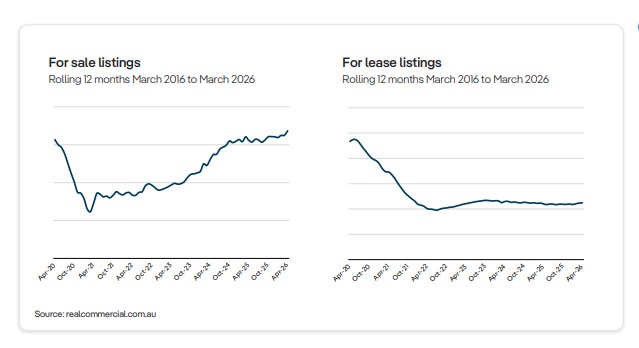
Commercial 'for sale' listings have been higher over the past 12 months than in each of the proceeding five years, the report said.
Medical/consulting (+16%), industrial/warehouse (+8%), and retail (+6%) market segments have seen the largest lift in listings year-on-year.
At the same time, total 'for lease' listings remain relatively steady and well below the peak vacancy levels during the pandemic.
However, CBD office vacancies remain considerably higher than pre-pandemic levels in both Sydney and Melbourne while remaining much the same in other capital cities.
Industrial, retail property remains buoyant
The report forecasts industrial property is likely to remain supported in 2026 by e-commerce growth, logistics demand, and limited industrial land across major cities.
Low vacancy rates also support rental growth in most precincts, the report notes.
"Online retail continues to support warehouse demand with rising online spending, particularly in food, helping to underpin the long-term case for industrial property."
Retail real estate sales have also increased in recent years with volumes at the second highest level on record in 2025.
Unlike other sectors of the market, sales volumes have remained strong over the first quarter of 2026, driven largely by shopping centres.
However, movement in retail rental yields has been variable on a national basis.
What's ahead for the commercial property sector in Australia?
Report author and senior economist at realcommercial.com.au Anne Flaherty said ongoing market performance will depend on how competing forces play out.
"The 2026 federal budget has introduced significant changes for residential investment which could encourage some investors to explore commercial property," she said.
"Elevated interest rates and slowing economic conditions are likely to keep weighing on activity while high stock levels, resilience in key sectors, and the relative attractiveness of commercial property following the federal budget help to support demand."
See also: How to buy a commercial property
Is it riskier to invest in commercial property than residential property?
Commercial property generally carries a higher risk-reward profile than the residential market.
Commercial properties typically require a larger capital investment and also carry higher risk of vacancy.
However, commercial rental yields also tend to be higher with longer-term, more stable leases in place.
Unlike for residential properties, commercial tenants tend to cover most of the everyday expenses such as council rates, insurance, and maintenance.
But commercial vacancy rates, rents, and property values tend to be much more tied to economic fluctuations than the residential sector which is more influenced by population growth and housing supply.
Commercial sector may see more SMSF activity
With SMSFs no longer allowed to take out a loan to purchase residential property, it's likely some may turn to commercial property as an alternative.
ATO figures show SMSFs currently account for more than a trillion dollars in assets with commercial property accounting for more than 10.5% of that value compared to 5.5% for residential property.
ATO data shows 11% of SMSFs had what's called a limited recourse borrowing arrangement (LRBA) in the 2023-24 financial year, most common among SMSFs with a balance between $500,000 and $1 million.
After the budget bill is officially legislated, SMSFs will have 45 days to finalise residential property contracts and loans already commenced.
At this stage, the deadline is expected to be some time in mid- to late-August.
Sale contracts and loans finalised before this time will not be affected by the new rules.
They will also not apply to SMSFs refinancing under an existing lending arrangement or to commercial property purchases.
Advertisement
Looking to take control of your retirement? This table below features SMSF loans with some of the most competitive interest rates on the market.
| Lender | Home Loan | Interest Rate | Comparison Rate* | Monthly Repayment | Repayment type | Rate Type | Offset | Redraw | Ongoing Fees | Upfront Fees | Max LVR | Lump Sum Repayment | Extra Repayments | Split Loan Option | Tags | Features | Link | Compare | Promoted Product | Disclosure |
|---|---|---|---|---|---|---|---|---|---|---|---|---|---|---|---|---|---|---|---|---|
7.14% p.a. | 7.16% p.a. | $3,374 | Principal & Interest | Variable | $0 | $230 | 60% |
| Promoted | Disclosure | ||||||||||
7.39% p.a. | 7.41% p.a. | $3,458 | Principal & Interest | Variable | $0 | $220 | 70% | Disclosure | ||||||||||||
7.49% p.a. | 7.51% p.a. | $3,493 | Principal & Interest | Variable | $0 | $230 | 80% | Disclosure |