

- Home values under federal government guarantee price caps are growing at a faster rate than those above it
- Homes under the 5% Deposit Scheme's price caps gained 3.6% in the December quarter
- Homes above the caps gained 2.4% over the same period
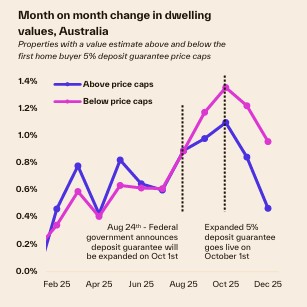
New data shows that since September, homes valued under the scheme's price caps have jumped 3.6% in the December quarter compared to 2.4% for homes above the caps.
Source: Cotality
The graph above shows prices for both were tracking at a similar rate before the announcement of the expanded First Home Guarantee in August last year.
See also: Australian Government 5% Deposit Scheme
Property analytics company Cotality found a clear divergence based on whether properties fall under or above the rebadged scheme's price caps, which differ according to location.
"The expanded 5% deposit guarantee has sharpened demand at lower price points, with under-cap markets outperforming across almost nine in ten regions," Cotality's research director Tim Lawless said.
Scheme driving property value growth in Sydney
The trend was most pronounced in the Sydney market where the price cap of property qualifying for the scheme is set at $1.5 million.
Homes valued below the cap jumped 2.3% over the quarter while the value of those above it fell 0.1%.
The pattern of stronger growth below local price caps played out in every Australian capital city and regional market, except for the ACT.
Across sub-regions, almost 90% of smaller local markets analysed also followed the national trend.
Trend already underway
But the pattern had already emerged before the expanded government scheme took effect on 1 October.
Mr Lawless put this down to "some buyers act[ing] early to secure properties before competition increased".
The early data appears to fly in the face of Treasury estimates that the scheme would have a 0.6% impact on home prices after six years.
However, the Cotality analysis said demand "brought forward" has likely increased competition and price pressure at the lower-end of the market, including from those who may not be relying on the deposit guarantee.
It also said elevated interest rates and home loan serviceability limits may be pushing overall demand toward lower-priced, more affordable properties.
The figures are also likely to reflect record levels of investor activity, particularly in lower-priced market segments.
Investors accounted for 40% of all new home loans in the September quarter.
Government standing by its numbers
Government "background figures" released after the first month of the scheme showed widespread uptake in October, accounting for around 10% of national home sales.
It coincided with Australia recording its highest jump in home value growth in October 2025 for more than two years.
At that time, the government said the uptake of guarantees was in line with Treasury estimates.
Treasury officials had said they expected around 70,000 guarantees to be issued over the first 12 months of the expanded scheme, around 20,000 more than under the previous program.
The 5,778 guarantees issued in October were in line with its monthly average estimate of around 5,800.
It was these numbers that "informed" Treasury's estimate that the expansion of the scheme will have a 0.6% price impact on house prices after six years.
Home approvals jump
The data comes in the wake of new figures showing home building approvals in November jumped to the highest level in almost four years, up more than 20% over the same time last year.
This was largely driven by new apartment approvals which recorded the highest numbers for more than seven years.
The figure was up almost 45% on the average of the past 12 months, the Australian Bureau of Statistics said, with Queensland and Victoria leading the charge.
Federal housing minister Clare O'Neil was quick to spruik the figures, saying they show home building continues to turn a corner on the back of the government's supply initiatives.
Despite the November data, new home construction is lagging well behind the federal government's target of building 1.2 million new homes by the middle of 2029.
Many analysts had warned the government's expanded 5% Deposit Scheme would only serve to drive home prices higher if Australia's housing shortage was not addressed.
Advertisement
Buying a home or looking to refinance? The table below features home loans with some of the lowest interest rates on the market for owner occupiers.
| Lender | Home Loan | Interest Rate | Comparison Rate* | Monthly Repayment | Repayment type | Rate Type | Offset | Redraw | Ongoing Fees | Upfront Fees | Max LVR | Lump Sum Repayment | Extra Repayments | Split Loan Option | Tags | Features | Link | Compare | Promoted Product | Disclosure |
|---|---|---|---|---|---|---|---|---|---|---|---|---|---|---|---|---|---|---|---|---|
6.19% p.a. | 6.23% p.a. | $3,059 | Principal & Interest | Variable | $0 | $530 | 90% |
| Promoted | Disclosure | ||||||||||
5.89% p.a. | 5.80% p.a. | $2,962 | Principal & Interest | Variable | $0 | $0 | 80% |
| Promoted | Disclosure | ||||||||||
5.99% p.a. | 5.95% p.a. | $2,995 | Principal & Interest | Fixed | $0 | $0 | 60% |
| ||||||||||||
6.23% p.a. | 6.23% p.a. | $3,072 | Principal & Interest | Variable | $0 | $395 | 70% | Disclosure |