More young Australians using AI for financial advice: New research


- A Queensland survey found almost half of young respondents are comfortable trusting AI for financial advice.
- Almost a third have taken investment advice from an AI, with about 27% using it for debt management strategies.
- RACQ Bank is urging everyone to still seek professional advice rather than just trusting the likes of ChatGPT.
The RACQ Bank survey of more than 500 young Queenslanders found 45% had followed financial advice from an AI without consulting an expert.
Nearly two thirds (65.8%) were comfortable using AI for budgeting and saving tips, almost a third (31.1%) for investment tips and about 27% for debt management strategies.
RACQ Bank spokesperson Ashleigh Paterson said that while tools like ChatGPT can be a "great resource" for general saving tips or suggestions, she's urging young Queenslanders not to rely on AI for more complicated or consequential financial decisions.
"Anything that encourages people to be proactive in managing their money is a great first step, however when it comes to more complex financial questions like how to invest your money, manage debts or buying a home, you should engage the support of a financial expert," she said.
What should you use AI for?
For general financial information or budgeting tips, tools like ChatGPT can quickly sift through the rest of the internet to come up with a useful response.
"AI-powered tools are a great resource if you're looking for ideas to reduce your weekly expenses, budget for a holiday or for general saving tips," Ms Paterson said.
For investing or choosing a specific financial product, AI can still offer plenty of useful information, but when it comes to actually making a decision there can be issues.
Many AI platforms such as ChatGPT rely on large language models, or LLMs.
This means they aren't actually thinking, just choosing the most probable next word or phrase based on the data it has been trained on, so it can 'hallucinate' which means presenting incorrect information as factual.
It's also taking into account its entire training database, so it's possible that its suggestions are based for example on sentiment in a sub-Reddit forum rather than a qualified financial professional's nuanced opinion or advice.
Financial advisor and founder of AJ Financial Planning Alex Jamieson says it's important to appreciate users often can't spot when the AI response is based on "incorrect or outdated datasets".
"If you don't have a deep knowledge of the topic, you aren't able to discern if the response is reliable and accurate," he told Savings.com.au.
ChatGPT suggests using its own service for general factual information (how do offset accounts or ETFs work for example) and explanations of financial concepts, and says it should not be relied upon for personalised financial advice.
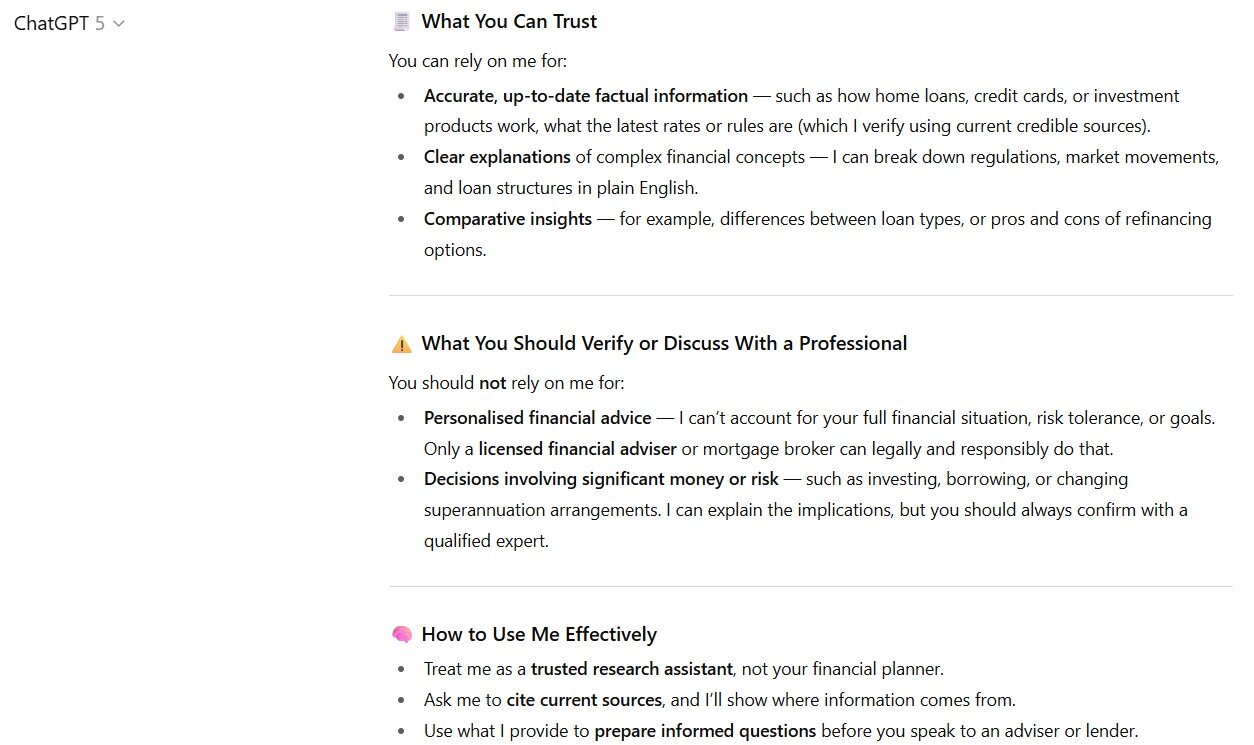
How ChatGPT recommends using itself for financial questions
What does the law say?
In Australia, to give a recommendation on a specific financial product (a term deposit for example or a stock) requires an Australian Financial Services (AFS) License, regulated by ASIC.
AI tools get around this by qualifying responses - ChatGPT for example usually makes it clear that it is not offering personal financial advice, just analysis customers can use to form their judgement.
As mentioned above though, this analysis may not always be completely accurate, and the AI also does not have the same responsibilities as a financial adviser who needs to consider the specific circumstances of each client.
ASIC 'concerned' about licensees using AI
Chatbots like Gemini and ChatGPT have only been in the public consciousness for a few years, so the regulatory approach remains in its infancy.
ASIC representatives have spoken about the potential risks of using AI for personal financial advice, and the regulator has also expressed concern about how AFS license holders are using AI.
"As the race to maximise the benefits of AI intensifies, it is critical that safeguards match the sophistication of the technology and how it is deployed," ASIC chair Joe Longo said last year.
"All entities who use AI have a responsibility to do so safely and ethically."