Housing affordability still a significant barrier to housing aspirations


Photo by Mitchel Lensink on Unsplash
This is according to the new AHURI report released today, The housing aspirations of Australians across the life-course: closing the ‘housing aspirations gap’.
According to this report, a large majority (87%) of Australians across all age cohorts, income groups and housing tenures are currently housed well, ranging from 80% of young adults to 94% of older Australians.
Over 90% of all age groups who currently own their own home are satisfied that their home state meets their long-term aspirations, compared to just one in five renters.
"Indeed, the vast majority of renters (between 68% and 78%, depending on age group) wanted to become homeowners, demonstrating that private rental is still seen as a transitional tenure for most," the report said.
'Safety and security' are the most important reasons to own a house, with 75% of respondents saying so.
"This attribute is most highly valued by older cohorts (86%), however it is also valued highly by large proportions of households in all age groups and across income groupings," the report said.
However, despite the desire to own a home and the importance of doing so for safety and security, many Australians are still struggling to break into the property market.
According to the report, between a quarter and a third of households across the different age groups experience considerable problems and costs in trying to achieve their housing aspirations.
Major barriers to finding appropriate housing include high-entry costs, lack of secure employment and an inability to meet the running costs of purchased or rented dwellings.
A lack of savings to build a deposit was the biggest barrier across every cohort:
- Young - 67%, with lack of stable employment the next highest at 38%;
- Mid-life - 64%, with lack of employment again the next highest at 36%;
- Older - 53%, with health issues the next highest at 39%;
- Very low income - 67% with lack of stable employment the next highest at 45%;
- Low income - 65%, with meeting rent or mortgage repayments the next highest at 36%; and
- Moderate income - the highest concern over deposit savings at 70%, with meeting repayments in second at 35%;
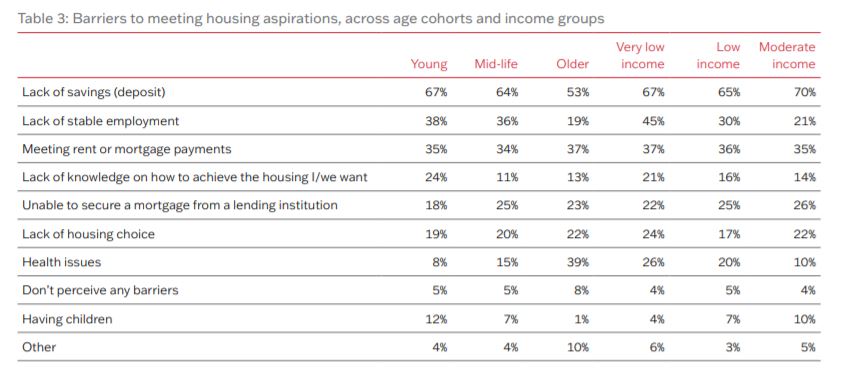
Source: AHURI
"Lack of choice in housing options is a third key barrier identified in this research, again consistent with emerging evidence about the lack of diversity within housing sub-markets that can cater to a range of life stage and household incomes," the report said.
"This includes young adults leaving home, families and ‘right sizing’ in later life.
“Housing affordability pressures play a significant role in the ability of households to meet their aspirations.”
[Read: National property prices decline over the June quarter]
Saving for a home the biggest savings goal for Australians
Despite the difficulty in doing so, new ANZ data shows that saving for a home has become the number one goal for its customers, rising to 22% from 19% between February and August 2020.
It has replaced the previous number one goal of saving for a holiday, which naturally fell off during COVID with domestic and international border closures.
This goal fell from 22% in February to 13% in August, and 8.7% are continuing to save for a rainy day.
ANZ Lead of Savings & Deposits Shannon Peachey said the pandemic has shifted what people are saving for, but 12,000 ANZ customers still set savings goals across one week in July.
“Whether you’re saving for a local holiday, a home or a car, effective goal setting is not always about struggling or sacrifice," Ms Peachey said.
"Instead it is about creating a realistic, healthy and sustainable plan that is achievable. We are encouraging everyone that is able to, to work towards positive savings habits to help increase their financial wellbeing."
To help reach a savings goal, whether that's saving for a house deposit, holiday or something else, here are ANZ's six tips for successful saving.
- Set SMART saving goals: "The best way to get a goal to work for you is to make it specific, measurable, achievable, realistic and timely. Doing this will help you feel focused."
- Name your goal: "Have some fun and give your goal a name. After all, saving is easier when you know what you're saving for."
- Visualise your goal: "Keep your goal front of mind with a visual reminder such as a photo, vision board or the wallpaper on your phone. Doing this makes you less likely to take money out."
- Plan and track your progress: "Create a savings plan capturing how and when you will add to your savings. Then, track your progress regularly."
- Enlist a money buddy: "Find someone who can support you and hold you accountable to your goal."
- Celebrate your milestones: "Whether you’ve reached your first third of your goal, or the halfway point, don’t forget to celebrate how far you’ve come."