Unemployment marginally increases as job market recovers in July


Photo by Benjamin Ashton on Unsplash
The figures from the Australian Bureau of Statistics (ABS) painted a more positive picture of the Australian job market, as employment increased by 114,700 people and hours worked increased by 1.3%.
However, with the marginal increase to unemployment, there are now more than one million people out of work and searching for a job.
The figures come in shy of the market consensus of the unemployment rate increasing to 7.8%, while forecasting was split between 125,000 jobs being lost and 150,000 being added, a reflection of how volatile the economy currently is.
Head of Labour Statistics at the ABS Bjorn Jarvis said while the results were encouraging, there was a significant difference between the current and pre-COVID-19 job market.
"The July figures indicate that employment had recovered by 343,000 people and hours worked had also recovered 5.5% since May," Mr Jarvis said.
"Employment remained over half a million people lower than seen in March, while hours worked remained 5.5% lower."
The increase to employment was largely driven by part-time employment, which added 71,200 jobs, while full-time employment saw 43,500 jobs added.
Hours worked for females was up 2.3%, compared to just 0.6% for males, with hours down for each down 4.9% and 5.9% respectively since the start of the pandemic.
Mr Jarvis said the figures didn't yet show the damage to the job market done by stage 4 restrictions in Victoria.
"The July data provides insight into the Australian labour market during Stage 3 restrictions in Victoria," he said.
"The August Labour Force data will provide the first indication of the impact of Stage 4 restrictions."
New South Wales saw the largest increase in employment in July, adding almost 60,000 jobs, followed by Victoria and Western Australia.
Monthly changes in labour force populations
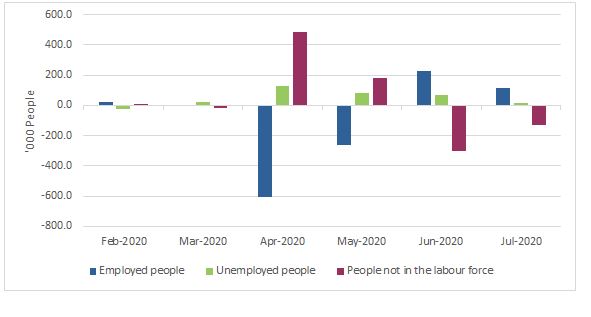
Source: ABS
Average earnings rise as low paid jobs lost
The ABS found the average ordinary time earnings for full-time adults in May was $1,714, seasonally adjusted, up 3.3% from November of last year.
Mr Jarvis said lower-paid jobs and industries were particularly impacted by COVID-19 restrictions, accounting for a high share of jobs lost.
“This fall in lower-paid jobs led to an increase in average earnings for all employees because the remaining jobs had a higher earnings profile," he said.
“In recent years, the six-monthly increase in average earnings for all employees has been around 1%.
"The 3.8% increase to mid-May highlights the extent of the major compositional change in jobs and earnings during this difficult period.”
Employees in the mining industry had the highest full-time weekly earnings at $2,697.50, while those in the accommodation and food services industry had the lowest at $1,139.30.
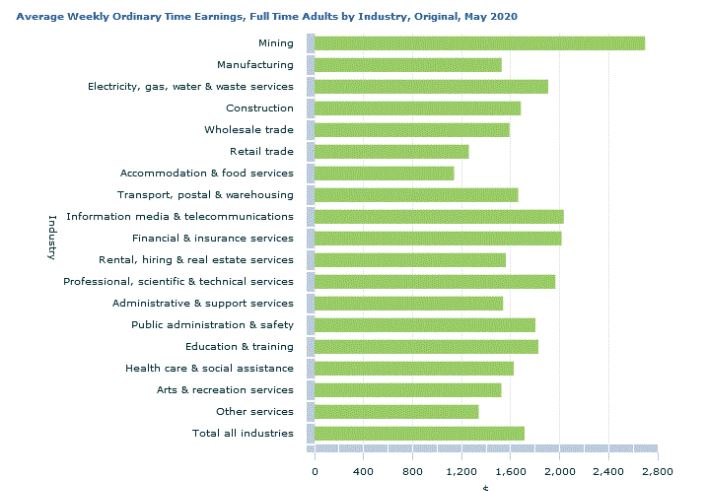
Source: ABS
More to come..