Energy saving tips for your home


Dominic Beattie
- Group Editor
- Experienced finance editor
- Writer
- Commentator and researcher
Do you like & trust our expert, human-written content?
Simply click this button to tell Google you want to see more of us in your Google Search Results, AI Overviews and AI Mode answers.
- Choosing appliances with higher energy efficiency ratings can mean using less electricity for the same outcome.
- Habits like closing doors and windows with the air-con on and keeping things turned off when not in use can help lower your energy bills.
- Solar panels can significantly lower your bill (sometimes even earn you money) but can be expensive to install.
Gas and electricity can be among the most significant household expenses, with all sorts of things driving up the cost. While factors like coal plant outages or war in the Middle-East are mostly outside of your control, there are probably still some things you could be doing differently to reduce how much you're handing over to your energy provider each year.
What is energy efficiency?
Energy efficiency is basically how much input it takes for a set amount of output. For example, LED bulbs can be just as bright as incandescent bulbs, but use 75% less power according to the Department of Energy. Improving your home's energy efficiency can lower your power bills without making lifestyle sacrifices.
What are energy efficient appliances?
Opting for energy efficient appliances like the aforementioned LED lightbulb can massively improve your overall efficiency. Appliances that aren't efficient waste power - incandescent bulbs for example work by heating a filament until it glows, which means most of the electricity goes towards heat not light.
The government provides energy ratings for consumer appliances, from one to six stars. Products have to meet a minimum efficiency standard to be sold in Australia, and then you can use the rating to compare different products. More efficient products might be more expensive, but you could save money in the long run on lower bills.
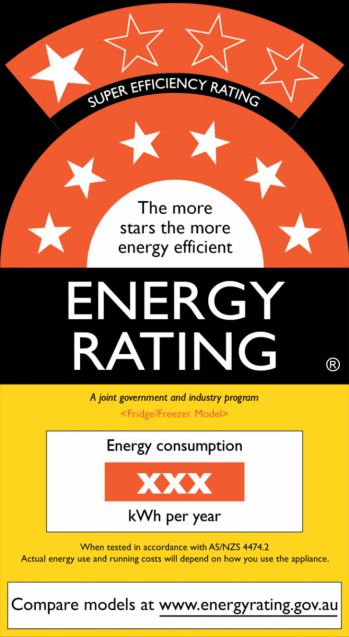
A sample energy efficiency label on energyrating.gov
The star rating system compares products with similar capacity and features. A fifty-inch television with a five star rating will use more energy than a five star thirty-incher, a bigger fridge will use more than a smaller one, you get the idea. It's generally recommended to choose less energy intensive options - the smallest fridge that fits your needs for example.
Cooling (and heating) your home more efficiently
Heating and cooling appliances account for about 40% of household energy use in Australia per EnergyRating. For most households, air conditioners, ceiling fans, electric heaters and the like use more energy than any other appliance, so improving the efficiency can be one of the most important ways to save on your bills.
There are three different efficiency ratings for appliances like air-con depending on the climate:
- Hot: Brisbane, Darwin
- Medium: Adelaide, Perth, Sydney
- Cold: Canberra, Hobart, Melbourne
Products have a different rating for cooling and heating in each climate. Some products might be excellent at cooling down a humid summer day in Cairns, but inefficient at keeping your Hobart home warm through the winter. If you're choosing an appliance, you should be able to find the ratings for the product you're considering to see whether it will suit your needs.
Outside of the appliances themselves, there are a few other steps you can take to help save on energy when you're trying to cool down your home:
Quick tips to cool your house efficiently
- Replace the filters on appliances: Full filters make air-conditioners or heaters work harder, lowering efficiency.
- Close doors and windows when the A/C is on: If you grew up in Australia you probably had a parent drill this into you, but in case you didn't know, leaving doors and windows open lets out the expensive cool air. The air-conditioner then has to work harder and run longer.
- Paint with cooler colours: Dark colours trap heat. A black external paint job might give you the gothic aesthetic you're after but it's probably also making your house more expensive to cool.
- Shade: Another way to stop your property getting too warm on a hot day is simply to block the sunlight. It's not an overnight fix, but a few trees in your yard can go a long way to keeping the house cool.
Or if you're trying to keep warm in a colder climate:
Quick tips to warm your house efficiently
- Try an electric throw rug: This could potentially save you hundreds each year compared to a portable heater.
- Let the sun do its thing: Even in winter the sun can be pretty warm. If you open the blinds and let the heat in when it is warm, you might not need to put the heater on as high later on when it cools down.
- Get some carpets: Carpets trap heat a lot better than wooden floorboards.
How to compare energy providers
There are probably many more energy providers in Australia than you're aware of. AGL, Origin and EnergyAustralia are the biggest names, but there's plenty of other providers out there including:
- Alinta
- Red Energy
- Powershop
- Dodo
- Lumo Energy
Different providers cover different areas, but wherever you are you should have several different options. Setting and forgetting might save you a bit of admin, but considering energy prices sometimes rise more than 10% in a year, you might be paying a premium for your loyalty. Like with home loans, providers sometimes offer discounted prices as incentive to switch over, so it can pay to be forever on the lookout for a better deal.
To help find the perfect plan, the Government offers a free energy provider comparison service. Customers in NSW, Queensland, South Australia, Tasmania and the ACT can compare offers at Energy Made Easy, while Victorian customers can head to Victorian Energy Compare.
Should you get solar panels?
Solar panels can significantly reduce your power bills, particularly in hotter parts of the country like Queensland or the Northern Territory. In some cases, you might even be able to sell what you don't use back to the grid, which you're paid for.
Solar panels convert sunlight into electricity, which is then sent to your home's electric panel. If you also install a solar battery, any power that you aren't using charges the battery for later when it isn't as sunny, or sold back to the grid for a credit.
The downside is solar panels can be expensive to buy and install. You might be able to get some money back through Government rebates (incentives for Australians to install solar panels), but can still expect to pay several thousand dollars to set up a solar system.
If you're looking at paying for solar with a loan, many lenders offer green loan products that are partly backed by the Government's Clean Energy Finance Corporation. These loans are generally available exclusively to customers buying 'green' features like solar panels or batteries, and often have significantly lower rates than other products on the market.
Savings.com.au’s two cents
Another potential benefit to a more energy efficient home is qualifying for green home loans. Similar to the aforementioned green personal loan products, green home loans are subsidised by the Clean Energy Finance Corporation so have lower than usual rates.
To qualify for a green home loan, your property usually needs to have a 7 star or more rating from the Nationwide House Energy Rating Scheme (NatHERS). These ratings are based on how energy efficient the property is, taking into account the design, insulation, and orientation among other factors (not including appliances).
If you're looking at renovating, it could be worth exploring whether you'll be able to make changes that will give your property a high enough NatHERS rating to switch the loan over, and save big over the loan term.