

What if you could get a home loan where the interest rate went down according to regular market cycles, but could only go up to a certain level?
Enter a capped home loan which can provide the benefits of a variable home loan without the drawback of your interest rate climbing too high.
What is a capped-rate home loan?
A capped-rate home loan is one that has a built-in rate ceiling for a certain period of time, typically a few years. It means no matter how much interest rates rise during that time, the interest rate on your loan cannot go higher than the cap.
What's the catch?
If this sounds too good to be true, it's worth noting capped-rate home loans tend to come with higher starting interest rates than other variable-rate loans on the market. (You don't think lenders are going to let you reap too many benefits after all.)
What's the difference between a capped-rate and a fixed-rate loan?
Unlike a fixed-rate loan that has an interest rate that stays the same for a set period, a capped rate loan has variable rate with a set maximum interest rate for an agreed time. This means the rate can go down during that period but never move above the cap.
In effect, a capped-rate loan acts as a safety net against rate increases but also comes with the potential for rates to drop in line with the market.
Additionally, with a capped home loan, you generally have the option to make unlimited additional repayments, unlike fixed-rate loans which typically don't come with such flexibility.
Are capped-rate home loans a good idea?
Like many home loan options, it can depend on what the market does which is largely out of the control of individual borrowers (and lenders).
Here's an example of how one could work:
Capt. Rate has a capped-rate home loan. The cap rate is 6% p.a. and the capped period is three years.
Capt. Rate’s interest rate cannot go above 6% p.a. during the first three years of the loan, even if the RBA lifts the cash rate.
Here's how it could play out during a fluctuating cycle of cash rate movements:
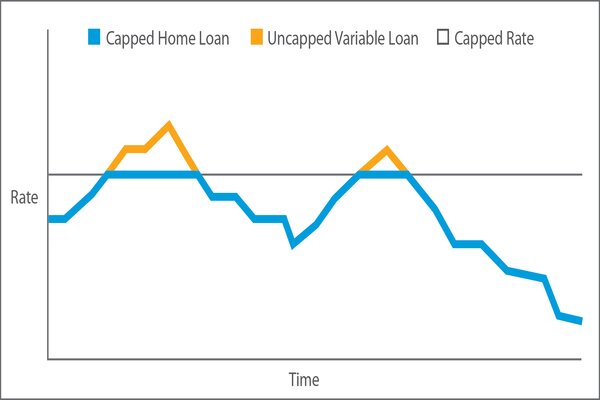
But, of course, it's very difficult to predict 'normal' interest rate cycles.
When would you take out a capped-rate home loan?
Capped-rate home loans may save you interest during a period when interest rates escalate rapidly.
Case study
As an example, let's say you took out a capped-rate home loan in the aftermath of the pandemic when interest rates were low - say April 2022. At this time, the average new owner occupier variable home loan rate was 2.4% p.a.
With capped home loans generally having higher rates than other variable-rate loans on the market, let's say you took out a capped rate loan at 2.8% p.a. with the interest rate capped at 4% p.a. for three years.
This scenario would have seen your cap kick in just four months later, ensuring your interest rate remained at 4% p.a. for the next two years and eight months.
During that time, Australia's average new owner occupier home loan rate peaked at 6.27% p.a. and remained around that level until the RBA's first cash rate cut in more than four years in February 2025.
By the time your loan came off the capped period in April 2025, average new variable home loan rates were around 5.51% p.a. and set to fall two more times in May and August 2025.
This above scenario would have seen you benefit from a capped home loan but, as always, it's extremely difficult to predict what interest rates are going to do over a three-year period, let alone a much shorter time frame.
Are capped-rate home loans common?
No, capped-rate home loans are exceedingly rare in the current home loan market.
Instead, many lenders prefer to offer fixed-rate or split-rate home loan options. The latter involves splitting your home loan between a fixed-rate and variable-rate portion.
Essentially, this means one portion of your loan (the fixed-rate part) will be protected from interest rate movements while the interest rate on the variable-rate portion will move up and down with the market.
See also: How to choose between a fixed-rate or variable-rate home loan?
Which lenders offer capped-rate home loans?
While capped-rate home loans are rare, you may find them through select customer-owned mutual banks or other smaller lenders.
But be sure to thoroughly research the market to ensure you're getting the best home loan for your circumstances. You may also want to consider the current cash rate cycle but even the best economists find this difficult to forecast.
The table below is a good place to start, featuring lenders with some of the lowest home loan interest rates on the market:
| Lender | Home Loan | Interest Rate | Comparison Rate* | Monthly Repayment | Repayment type | Rate Type | Offset | Redraw | Ongoing Fees | Upfront Fees | Max LVR | Lump Sum Repayment | Extra Repayments | Split Loan Option | Tags | Features | Link | Compare | Promoted Product | Disclosure |
|---|---|---|---|---|---|---|---|---|---|---|---|---|---|---|---|---|---|---|---|---|
6.19% p.a. | 6.23% p.a. | $3,059 | Principal & Interest | Variable | $0 | $530 | 90% |
| Promoted | Disclosure | ||||||||||
5.89% p.a. | 5.80% p.a. | $2,962 | Principal & Interest | Variable | $0 | $0 | 80% |
| Promoted | Disclosure | ||||||||||
6.38% p.a. | 6.66% p.a. | $3,121 | Principal & Interest | Variable | $299 | $0 | 85% | |||||||||||||
6.23% p.a. | 6.23% p.a. | $3,072 | Principal & Interest | Variable | $0 | $395 | 70% | Disclosure |