What is a mortgage broker?
A mortgage broker can help you find the right home loan to finance your property. But do you really need one when you can deal directly with a lender?



Dominic Beattie
- Group Editor
- Experienced finance editor
- Writer
- Commentator and researcher
Do you like & trust our expert, human-written content?
Simply click this button to tell Google you want to see more of us in your Google Search Results, AI Overviews and AI Mode answers.

- Mortgage brokers are licensed, ASIC‑regulated intermediaries who help borrowers get home loans and lenders get customers.
- In Australia, mortgage brokers are legally required to act in borrowers’ best interests when recommending home loans.
- Brokers are usually paid by lenders via upfront commission, meaning many borrowers pay no direct fee for standard home loans.
Australia’s home loan market can be a jungle, with roughly $30-40 billion in new residential loans approved each month. With that amount of money changing hands, it’s hardly surprising there are many players getting in for their slice of the action, mortgage brokers among them.
Almost three-quarters of all new home loans written in Australia come through a mortgage broker, with the total home loans settled by brokers exceeding $350-400 billion a year.
The graphic below shows how rapidly the share of home loans settled through brokers has grown since 2020.
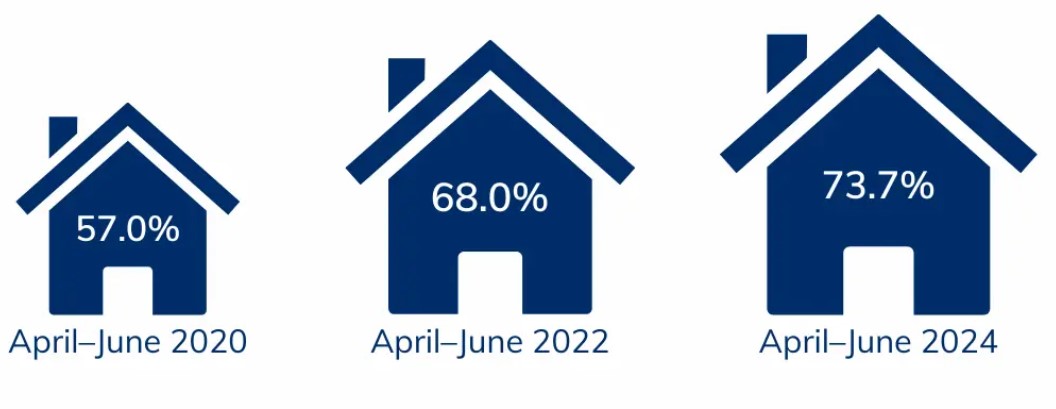
Source: Mortgage and Finance Association of Australia's quarterly survey of leading mortgage brokers and aggregators
It's no surprise that the number of mortgage brokers in Australia has also steadily grown. At last count in late 2024, the number was over 22,000, or around one mortgage broker for every 1,300 people.
So, what exactly is a mortgage broker? What do they do, do you actually need one, or is it better to find a home loan yourself? Let's find out.
What is a mortgage broker?
A mortgage broker is a person (or business) who essentially plays matchmaker between property buyers and lenders. They are middle people who help borrowers get home loans and lenders get customers.
In Australia, mortgage brokers are licensed, regulated, and legally required to act in the client’s best interests.
What do mortgage brokers do?
Mortgage brokers work on the borrower's behalf to arrange appropriate finance for them to purchase their home, offering advice and guidance throughout the process.
A good broker will:
- Work out what you can afford to borrow
- Understand your property goals and help you achieve them
- Compare loans across multiple lenders
- Come up with options suitable to your circumstances
- Explain various loan products (fixed or variable rate, split loans, etc.), what they cost, and what features they have (offset, redraw, etc.)
- Manage the home loan application and associated paperwork
When to go through a mortgage broker?
There is no right or wrong answer to this. It depends on your knowledge, confidence, and individual circumstances.
Here are some questions to ask yourself:
- Am I confident in navigating the home loan market?
- Can I get better access to a desired product by going direct?
- Will I save money by going through a broker?
- Do I have in-depth knowledge of loan types and features?
- Whichever way you go, it pays to do some research of the home lending market and products yourself. This way, even if you decide to go through a broker, you can better evaluate the advice and products recommended, ask some pertinent questions, and have a better understanding of the information provided.
See also: Home Loans 101
Why use a mortgage broker?
The home lending market is awash with lenders and products, each with its own terminology and jargon.
It's understandable many borrowers, especially first-timers, are hesitant to go shopping for a home loan on their own as there are real risks involved in getting it wrong. These include getting an expensive mortgage or locking themselves into loan terms and conditions they don’t fully understand.
Mortgage brokers can provide a guiding hand in helping you identify what you need in a home loan, come up with suitable products (among the thousands available on the market), and guide you through the application process and seeing it settled according to your needs.
Savings.com.au's two cents
The decision to go with a mortgage broker depends on your individual circumstances.
Brokers can not only provide convenience and advice but also provide an ongoing contact even after you've settled on a new loan and home. If you later decide to refinance with to get a better deal, the broker can also help you through this process.
Of course, going direct remains an entirely viable option. This often comes down on how much time you have and how confident you feel in navigating the home loan market yourself.
Another approach is to do some research yourself and present a shortlist of loan products to a broker to see whether they can match or improve on them. That way, you enter the process informed, while still benefiting from the broker handling the application and paperwork.
How mortgage brokers work
Say, you decided to engage a broker to help you find the right home loan for your needs and manage the application. Here’s how the whole process typically works.
Step 1: Initial consultation
It begins with a detailed discussion between you, the borrower, and the broker. At this stage, your broker usually collects details about you that are pertinent to the home loan application. These include:
- Income details
- Employment history (and whether you're employed or self-employed)
- Expenses and living costs
- Assets and liabilities
- Credit history
- Deposit size and source
- Property type (is it established owner-occupied, new build, investment, or refinance?)
This helps your broker assess your borrowing capacity, understand your goals, and is part of the Responsible Lending and Best Interests Duty requirements.
See also: How to improve your chances of getting a home loan
Step 2: Loan research and comparison
Once your broker has run borrowing calculations to determine a realistic borrowing range for you, they typically then compare suitable loans across their lender panel.
Under Australian law, your broker must act in your best interests, recommend a loan that is suitable (plus one or more alternative options), and provide an explanation why the loan was chosen, i.e. pros and cons.
Step 3: Loan application preparation
Once you’ve confirmed the loan you prefer, your broker prepares the application, collects supporting documents from you (your ID, payslips, tax returns, bank statements), ensures the documents you provided meet lender requirements, and submit the application to the chosen lender.
Step 4: Lender assessment and property valuation
At this point, the lender reviews your application, assessing your financial and property details. Your broker will act as the point of contact and will handle any inquiries the lender may have.
Once the lender orders a property valuation, your broker will typically coordinate valuation access and review the results.
Step 5: Approval and settlement
Once conditions are satisfied and the lender issues a formal (unconditional) approval, your broker is expected to explain to you the loan documents. Confirm interest rates, repayments and features, and ensure names and the loan structure are correct.
At settlement, your broker coordinates with conveyancers/solicitors and confirms settlement completion. But a broker’s role does not end here.
See also: Conditional vs Unconditional Home Loan Approval
Step 6: After-settlement support
Many brokers, at least the good ones, maintain long-term client relationships post-settlement. They don’t just disappear once documents are signed.
Ongoing support may include rate monitoring, refinancing advice, equity release strategies, and annual loan checkups.
How do mortgage brokers get paid?
Engaging a professional generally comes at a cost, whether a flat fee or an hourly rate, but mortgage brokers are paid differently. In many cases, borrowers may not even pay any fees at all, though it all depends on the broker and, to some extent, their home loan application.
Upfront commission
Mortgage brokers are typically paid by the lending institution, and not the borrower, upon the settlement of the loan. This is called an upfront commission.
This is usually based on a fixed percentage of the loan value, generally in the vicinity of 0.55-0.65%, plus GST. For example, a $500,000 mortgage with a 0.60% commission would see a broker take home $3,000 + GST.
Home loan with an offset account
Given this remuneration structure, the Hayne Royal Commission introduced the ‘net of offset’ model to prevent borrowers from being encouraged to take on larger loans. This calculates upfront commissions based on the net loan balance, that is, the loan amount minus any funds held in offset accounts.
So if a borrower takes out a $500,000 loan and holds $50,000 in an offset account after settlement, the broker’s upfront commission is calculated on $450,000.
Trail payment
In addition to upfront commission, some lenders may also pay mortgage brokers a trail payment (or trail commission). This is an ongoing payment, also based on the loan amount usually around 0.10% to 0.20% per annum, while the borrower remains a customer of the lender.
For instance, a 0.20% trail commission on a $400,000 mortgage will put $800 annually or $66.67 per month into your broker’s pocket for as long as your loan remains active.
Upfront fee
Also known as an administration or engagement fee, an upfront fee is a one-off charge that typically ranges from several hundred to several thousand dollars. It used to cover the time and costs a mortgage broker incurs in providing their services.
An upfront fee also serves as a safeguard for brokers, ensuring they receive compensation for services rendered even if the deal falls through and they are not paid by the lender.
- The Australian Securities and Investments Commission (ASIC) has found that most mortgage brokers do not charge upfront fees for standard home loans, though fees may apply in complex scenarios. Take note, however, that any such fees must be disclosed upfront.
Ethical standards regarding mortgage broker remuneration
Mortgage broker remuneration has been under scrutiny for several years.
In the wake of an ASIC review in 2017, the Hayne Royal Commission report in 2019 highlighted potential conflicts created by lender-paid commissions.
It pointed out that brokers were more likely to recommend products according to the commissions they stood to make rather than those that were in the best interests of their clients.
While the commission recommended borrowers pay brokers directly, this was not adopted. Instead, regulators introduced stricter rules in 2021 requiring brokers to act in their clients’ best interests, with penalties for breaches.
One way to check rates and products suggested by a broker is by comparing the loans with similar direct home loan options.
If you’re shopping for a home loan, the comparison table below features home loans with some of the lowest interest rates on the market for owner occupiers.
| Lender | Home Loan | Interest Rate | Comparison Rate* | Monthly Repayment | Repayment type | Rate Type | Offset | Redraw | Ongoing Fees | Upfront Fees | Max LVR | Lump Sum Repayment | Extra Repayments | Split Loan Option | Tags | Features | Link | Compare | Promoted Product | Disclosure |
|---|---|---|---|---|---|---|---|---|---|---|---|---|---|---|---|---|---|---|---|---|
6.19% p.a. | 6.23% p.a. | $3,059 | Principal & Interest | Variable | $0 | $530 | 90% |
| Promoted | Disclosure | ||||||||||
6.14% p.a. | 6.05% p.a. | $3,043 | Principal & Interest | Variable | $0 | $0 | 80% |
| Promoted | Disclosure | ||||||||||
6.38% p.a. | 6.56% p.a. | $3,121 | Principal & Interest | Variable | $199 | $0 | 70% | |||||||||||||
6.23% p.a. | 6.23% p.a. | $3,072 | Principal & Interest | Variable | $0 | $395 | 70% | Disclosure |





How many loan products do mortgage brokers consider?
One of the commonly cited limitations of using a mortgage broker is that they often only peddle a limited number of home loan products from a limited number of lenders.
Indeed, ASIC's 2017 investigation into the mortgage broking industry found 58% of consumers received only one or two loan options from brokers.
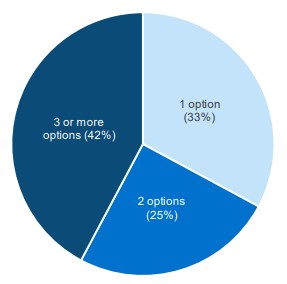
Source: ASIC
But more recently, the peak national body for brokers, Mortgage and Finance Association of Australia (MFAA) says brokers can typically access between 30 and 60 lenders to drive a good deal on behalf of their clients.
The MFAA says its members collectively access more than 100 lenders who all have to compete in the market for borrowers' business, effectively helping drive competition in the home loan sector.
Listen to mortgage broker Rebecca Jarrett-Dalton, founder of Two Red Shoes mortgage broking, speaking to the Savings Tip Jar podcast.
Do you really need a mortgage broker?
Whether you need a mortgage broker depends on your financial knowledge and confidence in navigating the property and lending markets yourself.
The alternative to engaging a mortgage broker is for people to do the legwork themselves, which is often referred to as going 'direct'.
Is there a perk if you go direct?
In recent years, some lenders, particularly larger banks, have taken exception to mortgage brokers taking a larger slice of their home lending margins. Some have fought back by offering 'direct-only' home loan products, often with interest rates below those offered to brokers, effectively cutting them from loan deals.
Australia's largest home lender Commonwealth Bank has gone down this path with its broker-free online home lender Unloan and its Digi Home Loan which is available directly to new and refinancing customers and not accessible through broker channels.
See also: How to refinance your home loan
Mortgage broker vs Direct lender: Key differences
In Australia, an alternative to getting a home loan through a mortgage broker is going directly to a lender.
Borrowers often go direct to lenders because of existing banking relationships through other products such as savings accounts or car loans, or to access direct-only products with attractive rates or terms.
Both options are legitimate and regulated, but they work very differently.
Feature | Mortgage Broker | Direct Lender |
Who you deal with | Mortgage broker | Bank or lender itself |
Loan options | Multiple lenders | One lender only |
Application support | ✅ | Self service |
Strategy support | ✅ | ✅ May be limited |
Potential access to special rates | ✅ | ✅ |
Ongoing loan review | Often included | Usually not proactive |
Pros of using a mortgage broker
Access to multiple lenders
Most brokers have panels of 30-60 lenders (per MFAA), which means you will have access to multiple options, maybe even including lenders you can’t easily approach directly.
Best Interests Duty
Since 1 January 2021, brokers are bound under the Best Interests Duty in the National Consumer Credit Protection Act 2009 (NCCP Act) to recommend a loan that suits each client and to consider whether that product offers the consumer net benefit relative to other options.
Ideal for complex borrower situations
If you are self-employed, have high loan-to-value ratio (LVR), or a borrower with multiple properties, engaging a broker can be particularly valuable for strategy and structuring advice.
Ongoing support
Good brokers don’t just disappear after loan settlement, they maintain an ongoing relationship and offer post-settlement support such as rate reviewing and assisting with refinances or equity releases.
Cons of using a mortgage broker
Limited to their lender panel
Your lender and loan options are limited to what’s in your broker’s panel. A broker cannot access every lender, and you may miss out on direct-only products or internal pricing that may be more competitive.
Quality varies between brokers
Not all mortgage brokers are created equal; experience, training, and ethics differ. A poor broker may lack product knowledge, miss better options, or be reactive rather than proactive. That said, choosing a well-reviewed, highly experienced broker matters.
Before engaging with one, ask them questions to help determine whether they are the right fit for you. More on that below.
Pros of going direct to a lender
Simplicity
Dealing with a single institution can mean a more straightforward process, with one point of contact throughout the journey. It is suitable for borrowers who value the convenience and comfort of working with a familiar and trusted brand (especially if they have an existing relationship with it) over the benefit of comparing multiple options.
Potential discounts or package deals
You may be eligible for staff-banking discounts, relationship-based pricing for long-term customers, and bundled packaged offers, among other benefits not available through third parties. In many cases, these incentives are not visible to brokers, making going direct more attractive for eligible customers.
See also: Home Loan Cashback Deals
A sense of greater control
If you value transparency, dealing directly with the lender making the credit decision can be more suitable for you. This can create a sense of greater control particularly for those who prefer managing their finances through their bank’s app, online portal, or local branch.
Cons of going direct to a lender
No market comparison
Since you’re going directly to a lender, you can only access the products they offer. You won’t know if another lender has a better rate or features, or if a policy elsewhere would allow higher borrowing unless you do the comparisons yourself.
Home loan comparison sites can offer a good oversight into what products are on the market. Their analytics can help narrow down the types of loans that meet your criteria and present you with numerous options to consider.
No obligation under Best Interests Duty
Unlike mortgage brokers, bank staff are not bound by Best Interests Duty. They can only recommend their own products and are not required to compare alternatives.
This does not mean, however, lack of protection for borrowers. In Australia, banks, credit unions, and other lenders are required to comply with Responsible Lending Obligations under the NCCP Act. This protects borrowers from being given a loan that is unsuitable for their financial circumstances.
Limited ongoing loan management
After settlement, ongoing management that a broker may be able to provide are typically limited if you go direct to a lender. Borrowers must review their rates, ensuring they remain competitive, and manage rate expiries (if they are on a fixed rate), among others.
Questions to ask a mortgage broker
Before choosing a mortgage broker to work with, make sure to evaluate them first. Asking these questions can help assess whether they are the right fit for you.
1. What are your credentials?
In Australia, brokers must hold an approved qualification such as a Certificate IV in Finance and Mortgage Broking (FNS40821) and either hold an Australian Credit Licence (ACL) or be an authorised credit representative under one, regulated by ASIC.
Some brokers also hold a Diploma of Finance and Mortgage Broking Management (FNS50320).
Membership of a professional body such as the MFAA or FBAA is another positive sign.
2. How many lenders do you have access to?
To give yourself the best opportunity to get a suitable home loan for your circumstances, you want your broker to have access to at least 20 lenders. If they only deal with two or three, you might as well go direct.
It also pays to check which lenders your broker deals with. It's better if they have a good mix of banks and non-bank institutions.
See also: Banks vs credit unions vs non-banks: what's the difference?
3. What are your fees and commissions?
Brokers are required to disclose how they’re paid. Understanding their fees and commissions can help identify any potential conflicts of interest and give you confidence your broker is acting in your best interests.

How to choose a broker
Go with your gut instinct as this is a relationship built on trust.
Be sure they have a variety of lenders on their panel, and check whether they have a team supporting them as this can often translate into speed in getting your application processed.
It’s also important to understand their fee structure and read online reviews to get a sense of their reputation and industry standing.
Frequently Asked Questions
There's generally no direct cost for using a mortgage broker for standard home loan applications, so their worth ultimately depends on the outcome they deliver.
If a broker secures you a suitable loan with a competitive interest rate and features that meet your needs, that’s a good result. However, if you could have qualified for a similar loan at a significantly lower rate, the difference could add up to tens of thousands of dollars in extra interest over time.
This is why it pays to do some research yourself so that you have a better idea whether the broker has found you a good deal or not.
You could try seeking advice from family, friends, and acquaintances who have used brokers, and research their recommendations. You could also check out brokers' reviews on Google, but as with anything in the murky world of online reviews, view these with a healthy scepticism.
Using more than one mortgage broker is possible, but it’s generally not advisable, especially if both are submitting loan applications on your behalf.
While it may seem like a way to access more loan options, it can quickly complicate matters, as each formal loan application lodged with a lender typically involves a hard credit enquiry, which can negatively affect your credit score.
No. Even when you apply through a broker, the lender takes on the financial risk of the borrower defaulting on the debt.
While they don’t bear credit risk, brokers still have a strong incentive to refer suitable borrowers, as consistently poor‑quality applications can damage their relationships with lenders.
Possibly. If you have bad credit, a mortgage broker may be able to find specialist or non-bank lenders that may be willing to approve you for a home loan. They can also guide you in strengthening your application to improve the chances of approval.
Mortgage brokers often have strong relationships with lenders and may have access to broker‑specific discounts or pricing, which aren’t always publicly advertised. They can also help negotiate rates on your behalf, particularly for competitive borrowers.
That said, it’s still worth comparing a broker’s offer against what you can find yourself to ensure you’re getting a good deal.
Yes. Mortgage brokers must either hold an Australian Credit Licence (ACL) or be authorised as a credit representative under one, and are regulated by ASIC.
While mortgage brokers themselves are not regulated by the Australian Prudential Regulation Authority (APRA), APRA supervises banks and lenders that brokers deal with.
Any complaints about a mortgage broker can be lodged with the Australian Financial Complaints Authority (AFCA).