Tiny Homes in Australia: Costs, Benefits and Key Risks


Dominic Beattie
- Group Editor
- Experienced finance editor
- Writer
- Commentator and researcher
Do you like & trust our expert, human-written content?
Simply click this button to tell Google you want to see more of us in your Google Search Results, AI Overviews and AI Mode answers.
Are you considering living in a tiny house?
- Tiny homes offer a lower-cost alternative to traditional housing in Australia.
- Prices of a tiny home typically range from tens of thousands to around $150,000 or more.
- Financing options differ from standard home loans and often involve personal or car loans.
- Legal rules vary by state and council, depending on whether the tiny home is fixed or on wheels.
- Tiny living can reduce ongoing costs but requires lifestyle compromises and careful planning.
Tiny homes have evolved from a fringe idea to a viable alternative for many Australians navigating a housing market that feels increasingly out of reach. With vacancy rates remaining at very low levels, house prices consistently going up, and construction failing to outpace demand, the appeal of an affordable - albeit small - home is understandable.
What is a tiny home
A tiny home is a compact dwelling, usually significantly smaller than a traditional house, designed to maximise space efficiency and minimise cost.
According to the International Residential Code (IRC) by the International Code Council (ICC), a tiny house is defined as a dwelling under 400 square feet (or 37 square metres).
They can range from simple cabins and small backyard units to fully equipped motorhomes. Some tiny homes are built on trailers (often classed as caravans or moveable dwellings), while others are constructed on a fixed foundation.
The tiny house movement gained traction in America during the late noughties as the global financial crisis hit, with many people looking to sell their expensive, large homes to move into smaller, more affordable ones.
Why tiny homes are gaining attention in Australia
Australia's housing market has seen steep price growth over the past decade, squeezing first-home buyers and renters alike. Many Australians now spend years saving a deposit while rental vacancy rates remain low and interest rates on mortgages stay high.
A perfect storm has helped to brew the housing crisis we've found ourselves in.
Let's cast our minds back to early 2019. Interest rates were at a then-record low, most of us had never considered the prospect of a pandemic, and the average price of an Australian home was under $650,000, according to the Australian Bureau of Statistics (ABS).
Cue 2020. The nation slammed to a halt as we tried to stop the spread of COVID-19. Few industries were left unscathed, and construction was no exception. Supply chain challenges, lockdowns, and restrictions on movements left a glut of unfinished homes dotted around the country, with major ramifications on housing supply.
We don't have enough houses, and we're not building new ones fast enough, with higher interest rates apparently now to blame for much of the building slowdown. In response, housing prices have soared. Per the ABS, the national median dwelling price passed $1 million in March quarter 2025.
How much do tiny homes cost in Australia?
Prices of tiny homes in Australia vary significantly depending on size, fittings, and whether you're buying or building.
Basic DIY tiny homes can be built for as low as tens of thousands of dollars if you have the skills and time, while typical professionally built tiny homes often range from roughly $80,000 to $150,000+, depending on design, materials, and features.
Tiny houses can be a very cost-effective way of living, according to Sarah Rohdich, co-founder and operations manager of tiny home-maker Häuslein Tiny House Co (Häuslein translates to 'little cottage' in German),
Ms Rodich said you can buy a "very nice" tiny house for $100,000 - over 10 times cheaper than the median house price in Sydney.
"A tiny house is in many ways a 'common sense' investment, especially with the Australian housing market as it currently is, and particularly for those looking to break into property ownership without bearing the burden of a draining 30-year mortgage," she told Savings.com.au.
Tiny Mobile's The Joey, for example, came with an $85,000 upon its launch in 2023. It measures 7.5 metres by 2.5 metres.
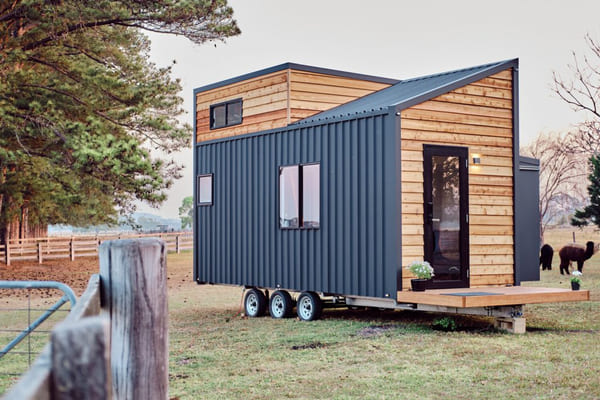
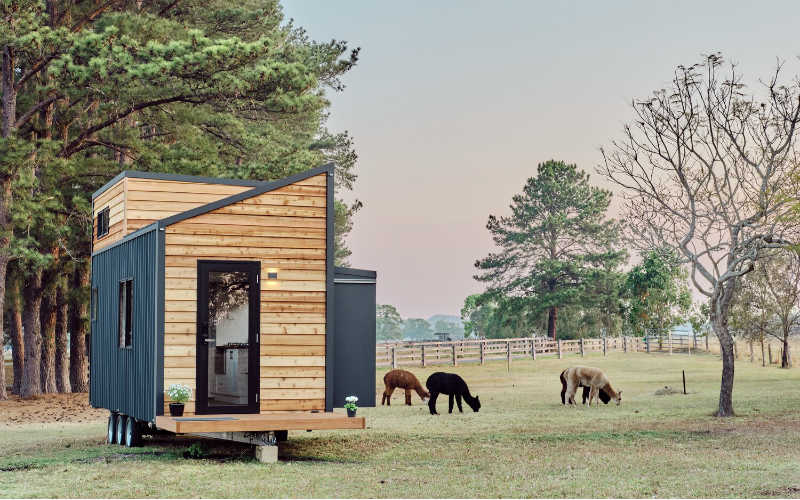
The Sojourner (Image supplied)
Common features of a tiny home
Generally, a tiny home comes with a bed, a kitchenette, and a bathroom. They can be 'parked' in a leased paddock, a friend's backyard, or on a parent's driveway, allowing an owner reprieve from the property market for a time.
Häuslein Tiny House Co offers a range of tiny house models, including the Little Sojourner and the Grand Sojourner.
The Little Sojourner
- Is 6m long
- Is 2.5m wide and 4.3m tall
- Has 20sqm of living space
- Has 1 queen bed, 1 bathroom and laundry
- Full kitchen and flip-up deck
- Can be towed by 4WD owners for flexibility
The Grand Sojourner
- Is 9m long
- 2.5m wide and 4.3m tall
- 32sqm of living space
- Has a downstairs bedroom and two lofts
- Can sleep up to six people
- Full kitchen and living space, bathroom and laundry
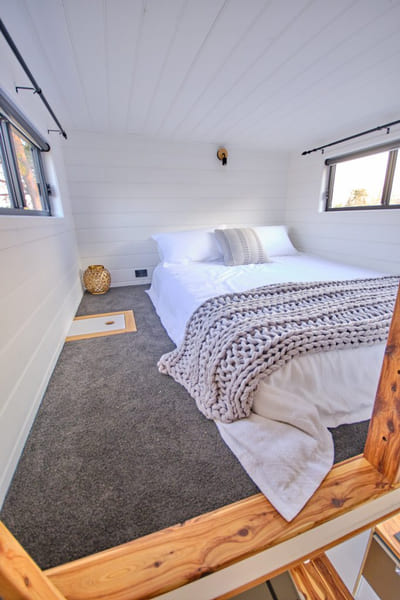
The Sojourner bed (Image supplied)
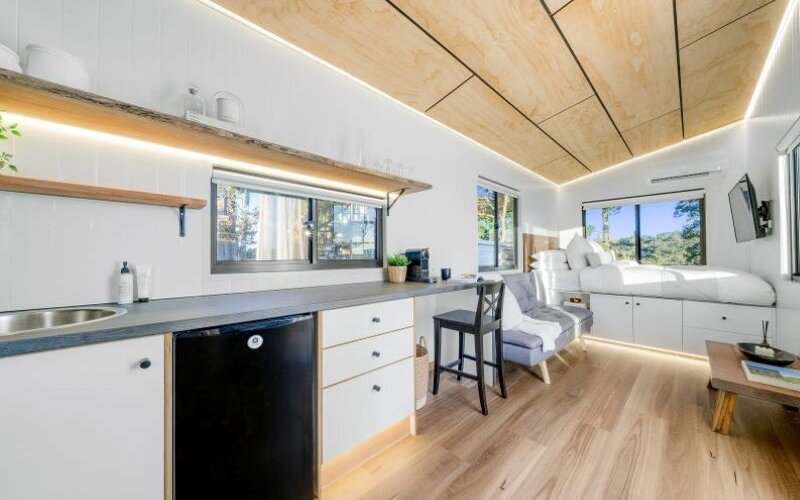
Tiny Mobile's tiny house (Image supplied)
Can you take out a loan for a tiny home?
As far as regulators are concerned, tiny homes on wheels are treated as movable dwellings (and may be regulated similarly to caravans), which can affect both where you can live in them and how they're financed - often via personal/RV-style loans rather than a standard mortgage.
Below are some of the lowest-rate unsecured personal loans currently available, which may be used to finance a tiny home:
| Lender | Car Loan | Interest Rate | Comparison Rate* | Monthly Repayment | Interest Type | Secured Type | Early Exit Fee | Ongoing Fee | Upfront Fee | Total Repayment | Early Repayment | Instant Approval | Online Application | Tags | Features | Link | Compare | Promoted Product | Disclosure |
|---|---|---|---|---|---|---|---|---|---|---|---|---|---|---|---|---|---|---|---|
6.24% p.a. | 6.95% p.a. | $389 | Variable | Unsecured | $0 | $10 | $495 | $23,334 | |||||||||||
5.95% p.a. | 5.95% p.a. | $386 | Fixed | Unsecured | $0 | $0 | $0 | $23,171 | |||||||||||
5.76% p.a. | 5.76% p.a. | $384 | Fixed | Unsecured | $0 | $0 | $275 | $23,066 |
|
This means the cost of borrowing could be higher in the short term, and tiny homes may not build equity in the same way as traditional property.
But unlike most recreational vehicles purchased through a car loan, Mr Davies argues the value of a tiny home won't necessarily depreciate.
"Identifying and understanding what a tiny house is is one of the things that we're having a bit of pushback on," he said.
"It is a caravan? If it is a caravan, it's a depreciating asset. But as a house, it is not a depreciating asset."
Mr Davies said he's working to educate lenders about Tiny Mobile's products in hopes of eventually providing a longer-term financing solution.
Work out your monthly repayment when you take out a car loan for a tiny home using Savings.com.au's Car Loan Calculator.
Financial benefits of a tiny house
- Lower entry cost - Tiny homes typically cost far less than traditional houses, making them attractive to those priced out of the housing market. For example, units around $85,000 to $100,000 are a fraction of Australia's median house price.
- Faster pay-off potential - Because of their lower price tag, tiny homes can be paid off more quickly than standard housing - in some cases, in just a few years - especially if financed with short-term loans.
- Lower living costs - Tiny homes use fewer building materials, less energy, and often have lower utility costs, particularly those designed for off-grid or eco-friendly living.
- Rental potential - Some owners use their tiny homes as short-term rental properties (e.g., Airbnb or similar platforms) to generate income. Tiny Mobile, for instance, has a short-term holiday letting platform connecting holidaymakers with tiny home owners.
Investment idea: Renting out your tiny home
"You could put a tiny home on a property, and you can start to save up for a deposit for a house," Tiny Mobile co-founder Eddie Davies told Savings.com.au.
"But once you get that deposit for a house … you can give that tiny home to us to manage. So, you now have a property, and you have an asset that's making money," he added.
"As an example, we've got a property out of Crescent Head, in northern New South Wales. We've seen 70% occupancy at $200 a night, which annualised is over $50,000 a year."
Note, however, that annual income from renting out a tiny home depends on various factors and results may vary.
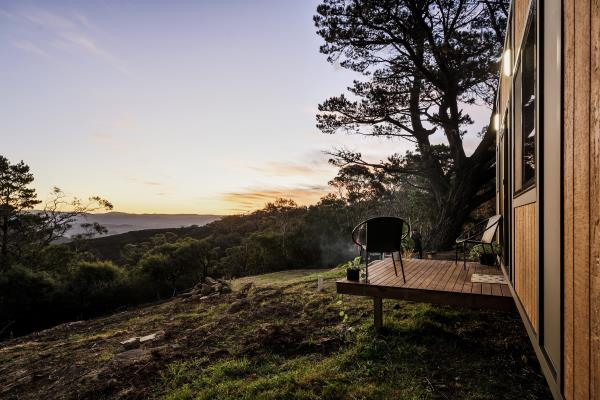
Lifestyle benefits of a tiny home
Beyond financial factors, many are drawn to tiny homes for lifestyle reasons:
- Minimalist living - Fewer possessions and a simpler lifestyle.
- Mobility - Tiny homes on wheels can be relocated.
- Sustainability - Smaller environmental footprint and the option for solar, rainwater and off-grid systems.
Whether these are seen as benefits depends on your personal priorities. Some people embrace the downsizing, while others find the limited space restrictive.
Drawbacks of a tiny home
Of course, tiny houses aren't a one-size-fits-all solution, and they definitely aren't for everyone. Here are a few drawbacks to consider if you're thinking about purchasing and living in a tiny home.
- Adjusting to a much smaller living space - Living in a significantly smaller home can be challenging, particularly for those used to more space.
- The reality of downsizing matters - Ms Rohdich says, while many people crave a simpler life (and a tiny house can help deliver that), the practicalities need careful thought.
- Everyday lifestyle compromises - Key questions to consider include: How big (or small) a wardrobe can you realistically live with? And how will you manage entertaining if hosting friends or family is important to you?
- Planning daily logistics is essential - While there's no shortage of creative and innovative storage and design solutions, Ms Rohdich warns it's worth getting day-to-day logistics clear before jumping in.
- Limited access to land - Another potential drawback is that tiny houses don't always come with attached land, and not every location is suitable.
- Council rules can be complex - Tiny homes are regulated differently depending on whether they're on wheels (often treated as a caravan/moveable dwelling) or fixed to the land (treated as a building and subject to building/planning rules), and requirements vary by state and local council.
Savings.com.au's two cents
Tiny homes can provide a lower-cost route to homeownership. But they're not a universal solution: legal hurdles, financing complexity, and space constraints, among others all need careful consideration.
Your decision on whether a tiny home is right for you should hinge on your lifestyle priorities, financial goals and local regulations. Tiny homes can be a stepping stone - many owners use them while they save for a larger property - or a long-term choice for those embracing minimalist living.
If you're seriously considering it, start by researching your local council's tiny home policies and speak with financiers about realistic borrowing options before you take the plunge.