'Green' cars in Australia: EVs, PHEVs, costs, and loan rates


Dominic Beattie
- Group Editor
- Experienced finance editor
- Writer
- Commentator and researcher
Do you like & trust our expert, human-written content?
Simply click this button to tell Google you want to see more of us in your Google Search Results, AI Overviews and AI Mode answers.
- 'Green' cars, including EVs and hybrid vehicles, are becoming more common in Australia, with government policy and lender incentives helping to drive uptake.
- Eligibility for lower-rate 'green' car loans vary by lender, but typically favours zero- or low-emissions vehicles such as EVs and plug-in hybrids.
- While green cars can offer lower running costs and environmental benefits, higher upfront prices, limited infrastructure, and model choice remain key trade-offs for buyers.
Electric vehicles (EVs) make up a growing share of Australia's car market, accounting for around one in six new cars hitting the road in recent years. Meanwhile, the New Vehicle Efficiency Standard (NVES) is targeting car manufacturers to encourage the sale of lower-emission internal combustion engine (ICE) cars.
Such 'green' cars are expected to be the way of the future, and many advocates say they're also cheaper to own (though, perhaps not to buy).
What is a 'green' car?
If you're seeking a car loan, you might have noticed two rates offered by many lenders: One for regular cars and another for 'green' cars. Given the latter is typically lower - sometimes significantly - you might be wondering what cars qualify as 'green'.
'Green' car loans are usually offered in partnership with the CEFC to encourage the uptake of low emissions cars.
Which cars are eligible for lower 'green' interest rates?
Fortunately or unfortunately, there's no set definition for a green car among lenders.
Some consider green cars to be those that are considered 'zero emission', like battery electric vehicles (BEVs), that run entirely off of a rechargeable battery. Others also count cars that produce very few emissions such as plug-in hybrid cars (PHEVs), which combine an ICE motor and a rechargeable battery to allow for shorter, electric-only journeys.
In the past, some lenders even extend the title to cars that simply produce lower carbon emissions than others. Though, this broader definition is uncommon these days.
Other vehicle classes that might fit the 'green' brief include:
- Fuel cell electric vehicles (FCEVs)
- Regenerative electric (non-plug in) vehicles (HEVs)
- Hydrogen vehicles
In the market for a new EV, PHEV, or other 'green' car? You might consider these low-rate financing solutions:
| Lender | Car Loan | Interest Rate | Comparison Rate* | Monthly Repayment | Interest Type | Vehicle Type | Maximum Vehicle Age | Ongoing Fee | Upfront Fee | Total Repayment | Early Repayment | Instant Approval | Online Application | Tags | Features | Link | Compare | Promoted Product | Disclosure |
|---|---|---|---|---|---|---|---|---|---|---|---|---|---|---|---|---|---|---|---|
6.09% p.a. | 6.23% p.a. | $581 | Fixed | Used | $0 | $0 | $34,874 | ||||||||||||
7.14% p.a. | 8.41% p.a. | $596 | Fixed | New | $8 | $499 | $35,761 | ||||||||||||
8.49% p.a. | 8.91% p.a. | $615 | Fixed | New | $0 | $0 | $36,921 |



How do EVs and PHEVs work?
How electric vehicles (EVs) work
EVs are powered entirely by an electric motor, which draws energy from a rechargeable lithium-ion battery pack instead of a traditional petrol or diesel engine. To run an EV, you'll need electricity - which is where charging comes in. EV batteries are charged by plugging the vehicle into an external power source, with charging typically falling into three categories:
Slow charging (Level 1 AC): Uses a standard household power point and provides a slow 'trickle' charge.
Fast charging (Level 2 AC): Uses a dedicated wall box charger, commonly installed at home.
Rapid charging (Level 3 DC): Uses public DC fast chargers, often located at shopping centres, highways, and service stations.
EV batteries store direct current (DC) electricity. When charging from a household socket or wall box, the vehicle converts alternating current (AC) electricity into DC via an onboard converter.
One often-overlooked advantage of EVs is regenerative braking. When the vehicle slows down, the electric motor reverses its function and captures kinetic energy that would otherwise be lost, feeding it back into the battery. Thus, slowing down helps recharge the car.
Battery size plays a similar role to a fuel tank in a traditional car. Larger batteries generally increase purchase price but allow you to drive further between charges.
How plug-in hybrid electric vehicles (PHEVs) work
Plug-in hybrid electric vehicles (PHEVs) combine two power sources: an electric motor with a rechargeable battery and a traditional internal-combustion engine.
Like EVs, PHEVs can be plugged in and charged using external electricity. They typically allow drivers to travel a short distance on electric power alone - often enough for daily commuting - before switching to petrol power once the battery is depleted.
This dual setup offers flexibility. Drivers can benefit from lower running costs and reduced emissions during short trips, while still having the petrol engine available for longer journeys or when charging infrastructure isn't readily available.
However, because PHEVs carry both a battery system and an engine, they tend to be heavier and more complex than either pure EVs or conventional cars.
How to compare cars' 'green' credentials
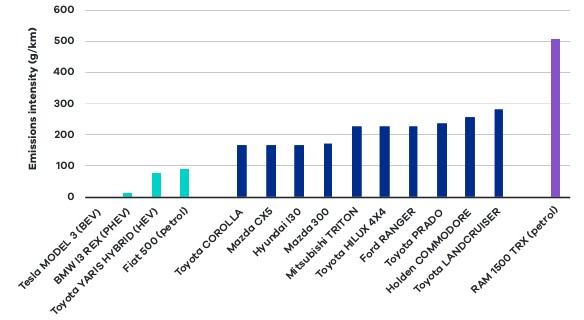
A Federal Government initiative dating as far back as 2004, the Green Vehicle Guide (GVG), can help consumers search and compare various vehicles based on their environmental performance. It mainly measures greenhouse gas emissions, primarily carbon dioxide (CO2), and displays how much of this carbon dioxide each vehicle emits in grams per kilometre (g/km).
- As of January 2025, the average Australian car emits 191g/km of CO2, with those newly registered emitting an average 156g/km and the worst offender emits more than 500g/km.
Average emissions of10 most common registered vehicles, plus other selected models:
Source: National Transport Commission's Light vehicle emissions intensity in Australia: trends over time (Jan, 2025)
As well as the CO2 (g/km), the Green Vehicle Guide provides information on the following:
Annual fuel cost estimate
This can help you compare how much it might cost to fill up your car's tank compared to other models, based on a set distance.The average fuel consumption (L/100km)
This can help you find the most fuel-efficient vehicle based on your needs.The energy consumption and electric range
For electric or hybrid vehicles, this can help compare which car has a better range (distance) and which is the most energy-efficient.The air pollution standard
Vehicles that score well on this produce lower levels of harmful pollutants, such as photochemical smog, hydrocarbons (HC) and oxides of nitrogen (NOx).Annual tailpipe CO2 emissions
This helps you compare a vehicle's contribution to greenhouse gas emissions over a given distance.
What are the downsides to buying a 'green' car?
While better for the environment (and often consumers' pockets), electric and hybrid cars still have their drawbacks. Some reasons drivers can be hesitant to buy an electric vehicle include:
Some brands and models can demand a higher upfront costAs uptake of EVs has risen in Australia, so to have prices, largely thanks to the introduction of cheaper brands like BYD. Still, though, EVs can be pricier than ICE vehicles, particularly if you've got your heart set on a top-of-the-line Tesla or Volvo.
'Range anxiety' Range anxiety is the fear than an EV could run out of battery on a long drive. The range available to an EV driver can be harder to speculate than that of an ICE vehicle driver, and a flat battery is likely more trouble to fix than an empty fuel tank.
A lack of charging stations and EV infrastructureWhile servos are hard to avoid, EV chargers can prove tricky to find. While EV infrastructure has ballooned in recent years, EV chargers are still dwarfed in population by traditional fuel bowsers.
Less model choiceMore and more new EVs and PHEVs have hit the market in recent years, but EV drivers still have fewer choices than ICE drivers.
Can you save money with a green car?
It is possible to save money with an electric or hybrid model, but how much you might save will depend on which car you get, how often you use it, and how you drive.
- According to the Electric Vehicle Council, the average Australian driver spends around $2,500 on petrol each year, equaling around $0.20 a kilometre. Meanwhile, charging an EV would cost the average driver around $500 a year, or $0.04 a kilometre, or even less for EV owners with solar panels or those able to charge their car in off-peak periods.
Pros and cons of owning a green car
✅ Pros of buying a green car
Environmentally friendly
If you're concerned about the climate, a green car is one of the most effective ways to reduce your carbon footprint.Government subsidies
You may be eligible for government subsidies, depending on your state or territory.Cheaper running costs
Depending on the car and driver, the cost to run an EV or PHEV may be cheaper than a traditional petrol or diesel car.Discounted car loan interest rates
Some lenders offer discounts on car loans for borrowers who purchase green vehicles.Modern technology
Green cars are generally quieter with more modern technology than traditional vehicles
❌ Cons of buying a green car
Fewer choices
Green cars still make up a small portion of the market, with fewer models available to choose from.Limited infrastructure
Charging infrastructure remains limited in some areas, and certain models have shorter driving ranges.Higher upfront costs
Some green cars come at a premium price tag, while the market for a used EV or green car isn't as mature as that of ICE cars, meaning there are generally fewer bargains to be found.
